
Pantheon FAQs: Your Most Common Questions Answered
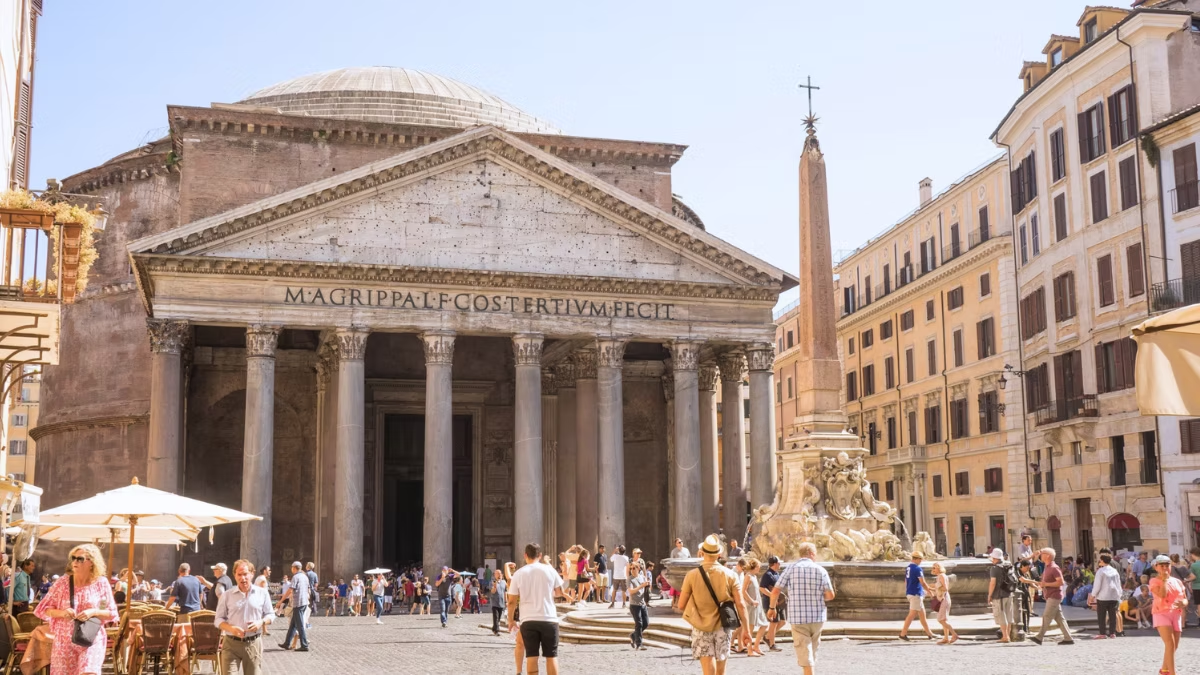
The Pantheon is open daily 09:00–19:00 (Mon–Sat) and 09:00–18:00 (Sun). Entry costs €5 for adults, €3 for EU citizens aged 18–25, and is free for under-18s and Rome residents. All visitors need a pre-booked timed entry slot. Shoulders and knees must be covered. Photography without flash is allowed. There are no toilets inside. The Pantheon is closed on 1 January, 15 August, and 25 December.
This page answers the questions visitors ask most often before and during their Pantheon visit, organised by topic for quick reference.
Tickets & Booking
How much does it cost to enter the Pantheon?
Adult entry is €5. EU citizens aged 18–25 pay a reduced rate of €3. Children under 18 and residents of the Municipality of Rome enter free. All free-entry visitors must still book a timed slot in advance.
Do I need to book in advance?
Yes. Since July 2023, all visits require a pre-booked timed entry ticket. Walk-in purchase is possible at the on-site ticket office, but queues regularly reach 45–60 minutes in peak season. Pre-booking is strongly recommended. For full booking guidance, see our Pantheon Tickets guide.
Where do I buy Pantheon tickets?
Official standard entry tickets are sold through the Musei Italiani portal (portale.museiitaliani.it) and at the on-site ticket office. Audio guide tickets and official guided tours are available at pantheonroma.com. Authorised third-party booking platforms also sell fast-track and combo tickets.
Is the Pantheon free on Sundays?
Only on the first Sunday of each month. On all other Sundays, the standard €5 entry fee applies. On free Sundays, no online booking is available — visitors collect free tickets at the entrance on a first-come, first-served basis. Crowds are very large on these days.
Is the Pantheon included in the Roma Pass?
No. The Pantheon is not included in the Roma Pass or the Omnia Card. A separate entry ticket is always required.
Can I cancel or change my ticket?
Refund policies vary. Official portal tickets are refundable only in the case of a portal malfunction. Name changes on official portal tickets are permitted once, within 72 hours of the visit date (from March 2026 onwards). Many authorised third-party tickets offer free cancellation up to 24 hours before the visit — check the specific policy at the time of booking.
What is the last entry time?
Last entry for individual ticket holders is 18:30 Monday–Saturday and 17:30 on Sundays. The ticket office closes at 18:00 Monday–Saturday and 17:00 on Sundays.
How far in advance do tickets sell out?
In peak season (April–October), popular time slots between 10:00 and 14:00 can sell out two to three days in advance. Booking at least three to four days ahead is advisable. Tickets for each calendar month are released in the middle of the preceding month.
Opening Hours & Closures
What are the Pantheon's opening hours?
Monday to Saturday: 09:00–19:00. Sunday: 09:00–18:00. Last entry is 30 minutes before closing.
What days is the Pantheon closed?
The Pantheon is closed on 1 January, 15 August (Ferragosto), and 25 December. Hours may also be adjusted during religious celebrations.
Is the Pantheon open on Mondays?
Yes. The Pantheon is open every day of the week, including Mondays.
Does the Pantheon close during Mass?
Ticket sales are suspended one hour before any scheduled Mass. Tourist entry pauses during the service. Regular Masses are held on Saturdays and holiday eves at 17:00, and on Sundays and public holidays at 10:30. Worshippers may enter freely during Mass. For full opening hours details, see our Opening Hours guide.
Getting There
Is there a metro stop near the Pantheon?
No. The closest metro stops are Barberini and Spagna, both on Line A, each approximately a 12–15 minute walk from the Pantheon. There is no metro station in Rome’s historic centre.
Which bus goes to the Pantheon?
Buses 30, 40, 46, 62, 64, 81, 87, and 492 all stop at Largo di Torre Argentina, a 4-minute walk south of the Pantheon.
Can I take a taxi to the Pantheon?
Yes. Taxis can drop you at or very near Piazza della Rotonda. Use official white Rome taxis with a meter.
How far is the Pantheon from Piazza Navona?
Approximately 300 metres — a 5-minute walk.
How far is the Pantheon from the Trevi Fountain?
Approximately 700 metres — a 10-minute walk. For detailed transport options, see our How to Get to the Pantheon guide.
Dress Code & Entry Rules
What is the dress code for the Pantheon?
Shoulders and knees must be covered for adults and teenagers. Sleeveless tops, short shorts, and mini skirts are not permitted. Hats must be removed on entry. Children under approximately 12 are generally exempt. Inappropriate dress may result in denied entry — no refund is given.
Can I wear shorts to the Pantheon?
Shorts are acceptable if they reach the knee. Shorts significantly above the knee are not permitted. If in doubt, carry a scarf or wrap to cover up.
Can I wear a sleeveless dress to the Pantheon?
Not without a cover-up. A sleeveless dress worn with a shawl or cardigan draped over the shoulders is accepted.
Are hats allowed inside the Pantheon?
Hats must be removed before entering. This applies to baseball caps, sun hats, and all other headwear.
Are large bags allowed?
Large backpacks and wheeled luggage are not permitted inside. Small day bags and handbags are allowed. All bags are inspected at the security screening.
Are animals allowed?
No, except for certified guide dogs and documented support animals.
Photography & Behaviour
Can I take photos inside the Pantheon?
Yes. Personal photography without flash is permitted throughout the interior. Flash photography is strictly prohibited.
Can I use a tripod?
No. Tripods are not permitted inside without a special permit. Commercial photography requires advance authorisation.
Is it OK to eat or drink inside?
No. Eating and drinking inside the Pantheon are not permitted.
Can I sit on the floor or the steps?
No. Visitors are not permitted to sit on the floor or on the steps of the niches.
What's Inside
What can I see inside the Pantheon?
The full interior of the Pantheon is open to all ticket holders. Key features include: the rotunda and dome, the 8.9-metre oculus, the ancient marble floor, seven decorative niches with altars, Raphael’s tomb, the tombs of Victor Emmanuel II and Umberto I, and Renaissance and baroque artwork installed over the centuries. For a full breakdown, see our Inside the Pantheon guide.
Where is Raphael buried in the Pantheon?
Raphael’s tomb is in the third niche on the left as you enter through the main doors. A bust above the sarcophagus bears his epitaph. For the full story, see our Raphael's Tomb guide.
Why does the Pantheon have a hole in the roof?
The oculus serves multiple purposes: it dramatically reduces the weight at the dome’s apex (the most structurally vulnerable point), provides the building’s only source of natural light, and functions as a symbolic connection between the interior and the heavens — originally important in a temple dedicated to all the gods. For more, see our The Oculus guide.
Does rain come through the oculus?
Yes. When it rains, water falls through the oculus onto the marble floor. The floor is very slightly convex and has 22 drainage holes at its centre that channel water into an ancient hydraulic system beneath the piazza. Visitors may remain inside during rain — it is one of the most extraordinary experiences the building offers.
Are there toilets inside the Pantheon?
No. There are no public toilets inside the monument. The bars and restaurants in and around Piazza della Rotonda have facilities available to customers.
History & Architecture
Who built the Pantheon?
The Pantheon as it stands today was built by Emperor Hadrian around 125 AD, replacing two earlier structures on the same site. The portico inscription reading “Marcus Agrippa built this” refers to Agrippa’s original building (27 BC), which Hadrian chose to retain out of respect for his predecessor. For the full history, see our History of the Pantheon.
How old is the Pantheon?
The current building dates from approximately 125 AD — nearly 1,900 years old. It is the best-preserved building from ancient Rome and has been in continuous use since its construction.
Why is the Pantheon so well preserved?
The Pantheon survived when virtually every other ancient Roman monument was stripped for building materials because it was converted into a Christian church in 609 AD under Pope Boniface IV. Its religious function protected it through the Middle Ages. Without this conversion, it would almost certainly have been quarried like the Forum and the Colosseum.
What does "Pantheon" mean?
Pantheon comes from the Greek words pan (all) and theos (gods). The building was originally dedicated to all the gods of Rome, though exactly which deities were worshipped there and how remains debated by scholars.
How big is the Pantheon's dome?
The dome has a diameter of 43.3 metres — equal to the interior height from floor to oculus. This creates a perfect geometric sphere within the rotunda. It remains the largest unreinforced concrete dome in the world, a record it has held for nearly 1,900 years.
Is the Pantheon a church?
Yes. Since 609 AD, the Pantheon has functioned as the Basilica di Santa Maria ad Martyres — a Catholic church dedicated to the Virgin Mary and the Christian martyrs. It is an active place of worship and holds regular Masses.
Practical Tips
How long does a visit take?
Most visitors spend 20–35 minutes inside on a self-guided visit. With an audio guide, allow 45–60 minutes. On a guided tour, the guided portion lasts approximately one hour, after which you may stay independently.
When is the best time to visit?
The first hour after opening (09:00–10:00) on a weekday is the least crowded. Late afternoon (after 15:00) on weekdays is the next best option. The busiest window is 10:00–14:00 in peak season (April–October). For full timing advice, see our Best Time to Visit guide.
What is the security queue like?
All visitors pass through a bag inspection and basic security screening at the entrance regardless of ticket type. At peak hours this takes 10–20 minutes. Build this into your arrival time.
Is the Pantheon accessible for visitors with disabilities?
The Pantheon is accessible at ground level via a side entrance with no step. The interior floor is flat marble throughout. Contact the Pantheon directly for specific accessibility requirements.
What should I do if my time slot sells out?
Switch to a guided tour option (which sometimes has different slot availability), try the official portal for late-availability slots, or visit in the early morning when walk-in slots are more likely to be available. See our Pantheon Tickets guide for all current options.
