
The Pantheon Door: Rome's Ancient Bronze Gates
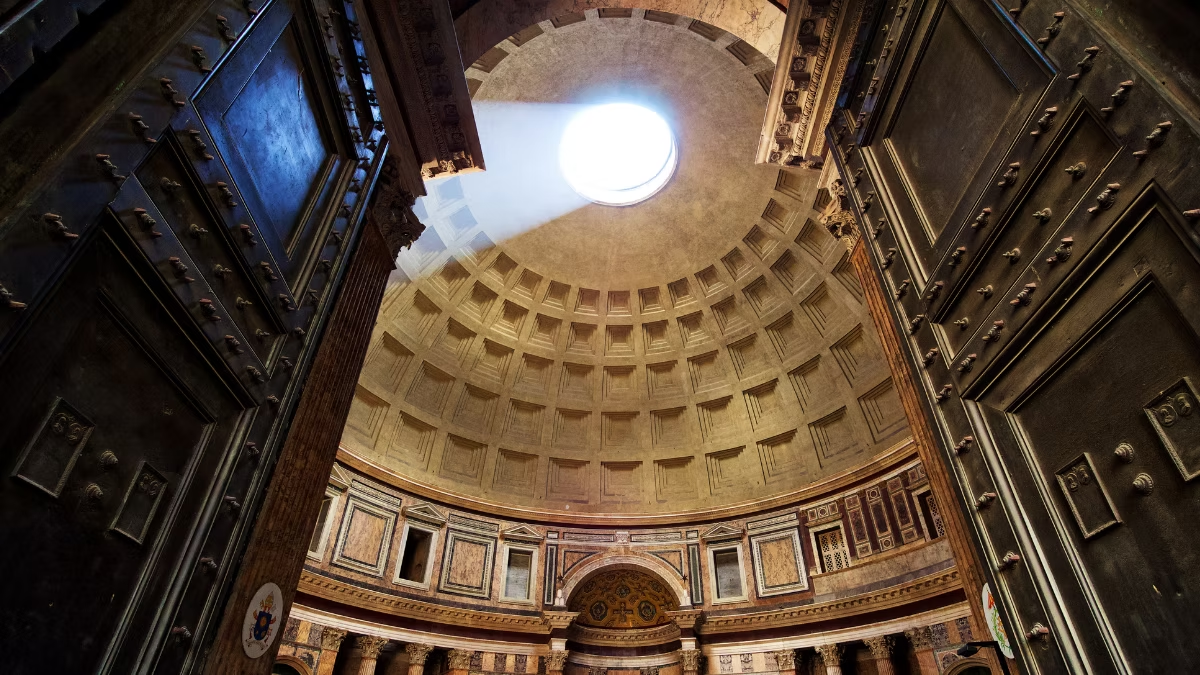
The Pantheon’s bronze doors are 7.53 metres tall and 4.45 metres wide, consisting of two leaves each weighing approximately 8.5 tonnes. They are the oldest surviving bronze doors in Rome. Despite weighing around 20 tonnes in total, they are so perfectly balanced on their original pivot pins that a single person can push either leaf open. The original lock still functions. Analysis of the casting technique confirmed they are Roman originals dating from Hadrian’s construction, around 118–128 AD — not medieval replacements as was long believed.
Most visitors walk through the Pantheon’s bronze doors without fully registering what they are passing through. They look impressive, certainly — but the scale of the entrance, the noise of the crowd, the anticipation of what lies inside, and the staff directing visitors all make it easy to move through without pausing. This would be a mistake. The doors are one of the most remarkable objects in Rome: nearly two thousand years old, still on their original hinges, still opened and closed every day, with a lock that still works. This article is their story.
The Dimensions
The Pantheon doors consist of two leaves, each pivoting independently. Together they span:
- Height: 7.53 metres (24.7 feet)
- Width: 4.45 metres (14.6 feet) total — approximately 2.23 metres per leaf
- Weight: approximately 8.5 tonnes per leaf — around 17–20 tonnes total
To put that in context: each door leaf weighs about as much as a fully loaded London double-decker bus. Standing beside the doors before entering, the scale is immediately apparent — the top of each leaf is almost three times the height of an average person, and the bronze surface stretches across a width that requires looking left and right to take in fully.
The Engineering: How One Person Opens 20 Tonnes of Bronze
The Pantheon doors can be opened by a single person despite weighing around 20 tonnes in total. This is because each leaf pivots on a precisely engineered pin set into the floor at the bottom and into the architrave above. The pivot pin is positioned not at the outer edge of the leaf but offset toward the centre of mass, creating near-perfect rotational balance. A small amount of force applied to the outer edge of either leaf is sufficient to swing it open.
The balance of the Pantheon doors is one of the most cited examples of Roman precision engineering. In a conventional door, the hinge is placed at the edge, and the entire weight of the door must be overcome to create rotation. The Pantheon doors use a different principle: each leaf pivots on a vertical pin set into stone sockets — one in the floor threshold, one in the stone architrave above — that pass through the bronze at a point calculated to balance the leaf as close to its centre of gravity as possible.
The result is that despite the staggering weight of the bronze, the pivot point is so precisely positioned that the door’s weight is effectively cancelled out. A single person applying gentle pressure at the outer edge of either leaf can swing it open or closed. No mechanical assistance, no counterweights, no hydraulics — just engineering that has remained accurate for nearly two thousand years without significant adjustment.
The doors have been opened and closed every day since they were installed. The threshold stone beneath each pivot pin shows the worn groove of nearly 1,900 years of rotation. This wear is visible to visitors who look down at the threshold as they enter — one of the most quietly astonishing details in the entire building.
The Lock
One of the most remarkable technical details of the Pantheon doors is that the original lock mechanism is still operational. The lock dates from the Roman period — approximately 1,900 years old — and remains one of only a small number of ancient locks still in working condition anywhere in the world. The lock secures the doors when the Pantheon is closed; the same mechanism that was used to lock the building for the night in Hadrian’s time still performs that function today.
Near the hinge area of each door, close inspection reveals marks left by iron tools — the marks of attempts made over the centuries to force the doors open. None succeeded. The lock held each time.
Are the Doors Originals or Replacements?
Analysis of the casting technique confirmed they are Roman originals — not medieval replacements. For centuries scholars believed they were 15th-century replacements because they appeared slightly too small for the door frames, but metallurgical analysis established that the casting method is consistent with 2nd-century Roman bronze work. They are among only three buildings in ancient Rome to have preserved their original bronze doors.
For a long time, the prevailing scholarly view was that the Pantheon’s current doors were medieval replacements — probably dating from the 15th century — because they appeared slightly too small for the door frames. The gap between the door leaves and the surrounding stonework seemed inconsistent with original Roman workmanship.
This view was overturned when metallurgical analysis of the doors’ casting technique was carried out. The fusion method used to create the bronze panels and the specific alloy composition are consistent with Roman imperial-period casting technology and inconsistent with medieval techniques. The conclusion: the doors are Hadrianic originals, cast between 118 and 128 AD.
The apparent misfit with the door frames is now explained by the raising of the Pantheon’s floor level over centuries of restorations — the door frames were partially buried, making the doors appear undersized relative to a frame that was originally deeper. The doors themselves are the correct size for the original frame dimensions.
This makes the Pantheon doors one of only three sets of original Roman bronze doors surviving in Rome. The others are at the Temple of Romulus in the Roman Forum and the Curia Julia (Senate House).
The Design
The surface of each door leaf is organised into a grid of rectangular panels framed by heavy mouldings — a pattern of coffered geometry that directly echoes the coffered ceiling of the dome inside. This is not coincidental. The doors function as an architectural introduction to the interior: the visitor’s eye encounters the coffer pattern at the threshold and then finds the same principle expanded to monumental scale on the dome above.
Bronze pilasters with fluting, surmounted by Tuscan capitals, flank both sides of the door frame, integrating the entrance into the portico’s architectural language. The overall effect is one of severe classical restraint — a frame designed to prepare the visitor for the interior without competing with it.
The doors were originally decorated with relief work depicting Roman mythological scenes, but these were removed or worn away over the centuries of Christian use, and Christian motifs were applied during the medieval period. The current surface is largely stripped of decoration — smooth bronze panels, framing mouldings, and the marks of age.
What Happened to the Bronze Roof Tiles
While the doors survived, the bronze that once covered the Pantheon’s portico roof did not. In 1625, Pope Urban VIII — of the Barberini family — ordered the bronze tiles from the portico ceiling stripped and sent to Gian Lorenzo Bernini to be melted down. Some was used for the baldachin over the high altar at St. Peter’s Basilica. The rest went to Castel Sant’Angelo for cannon. The loss prompted Romans to coin the famous phrase: “Quod non fecerunt barbari, fecerunt Barberini” — “What the barbarians did not do, the Barberini did.” The holes in the portico ceiling where the bronze fixings were attached are still visible today.
The survival of the doors, while the portico bronze was stripped, is partly explained by their function. The tiles were removable surface decoration; the doors were structural necessities — the only way to close and secure the building. Removing them would have meant leaving the building permanently open.
What to Notice When You Pass Through
Most visitors spend no more than a second or two passing through the Pantheon’s doors. With some foreknowledge, there is considerably more to notice:
The threshold: Look down at the stone threshold beneath each door leaf. The worn groove from nearly 1,900 years of the pivot pin rotating in its socket is visible — a physical record of every opening and closing since Hadrian’s time.
The size relative to visitors: Stand in the doorway and look up. The top of the door leaf is approximately 7.5 metres above the ground — roughly the height of a three-storey building.
The surface texture: The bronze surface of each panel shows the patina of nearly two thousand years of exposure and handling. Some areas near the lower edges are worn smooth by contact with visitors’ hands over the centuries.
The gap between leaves and frame: The slight gap between the door leaves and the surrounding stone reflects the floor level change noted above — not a defect of workmanship, but a product of nineteen centuries of geological and structural settlement.
The marks near the hinges: Close to the hinge area on the inner face of the doors, faint marks from attempts to force the doors using iron tools are visible. Every one of those attempts failed.
Practical Information
The doors are opened at 09:00 and closed at 19:00 Monday–Saturday (18:00 Sundays). Entry requires a pre-booked timed ticket. For full entry options, see our Pantheon Tickets guide. For information on what you will see inside once you pass through the doors, see our Inside the Pantheon guide.
Frequently Asked Questions
How old are the Pantheon’s bronze doors?
The doors date from Hadrian’s construction of the Pantheon, approximately 118–128 AD — making them nearly 1,900 years old. Analysis of the casting technique confirmed they are Roman originals, not medieval replacements as was previously believed.
How heavy are the Pantheon doors?
Each leaf weighs approximately 8.5 tonnes. The two leaves together weigh approximately 17–20 tonnes total.
How can one person open such heavy doors?
Because each leaf pivots on a pin positioned close to its centre of gravity, the weight is effectively balanced. A small force applied at the outer edge is sufficient to rotate either leaf. This precision engineering has remained accurate for nearly two thousand years.
Is the original lock still working?
Yes. The original Roman lock mechanism remains operational and is still used to secure the doors when the Pantheon is closed.
Are the doors original Roman work or medieval replacements?
They are Roman originals. Analysis of the casting technique established that the doors were made using 2nd-century Roman bronze methods and are contemporary with Hadrian’s construction of the building.
Can you touch the doors?
Visitors pass through the doors and may observe them closely, but touching or leaning against the ancient bronze surface is discouraged.
