
Inside the Pantheon: A Room-by-Room Guide
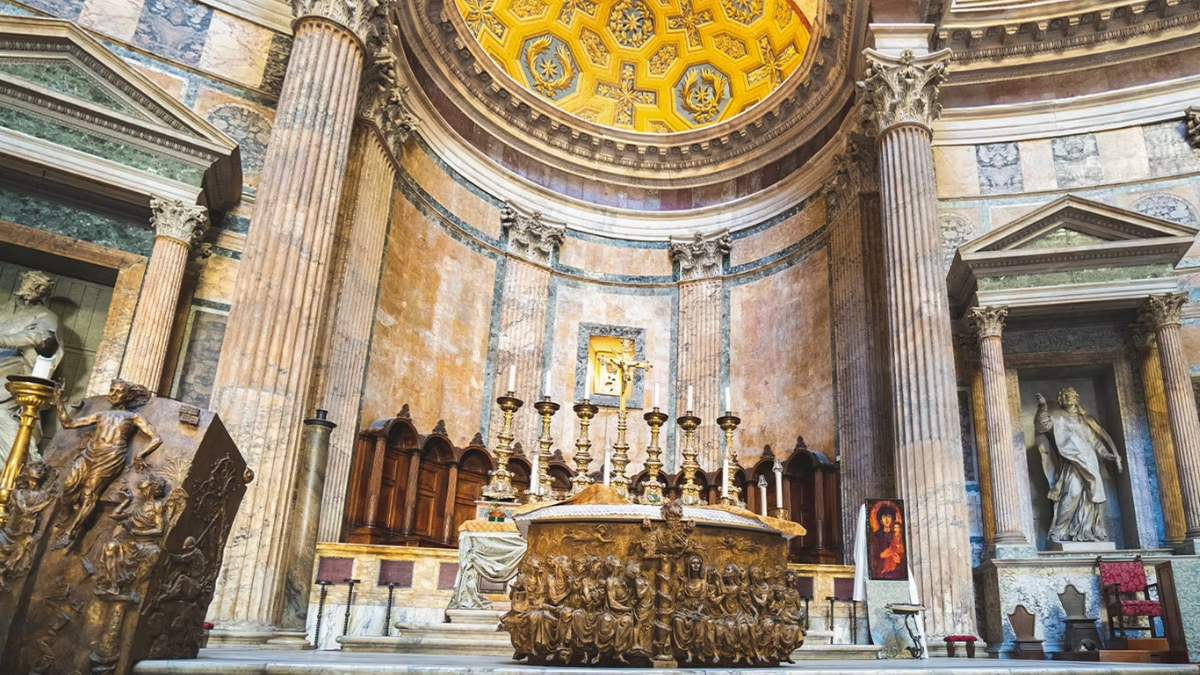
The Pantheon’s interior is a single circular room — the rotunda — 43.3 metres in diameter and 43.3 metres high. The coffered concrete dome, the oculus at its apex, the ancient marble floor, seven niches containing altars and tombs, and the tombs of Raphael and the Italian kings are the key elements. The interior houses 20+ types of marble. Raphael’s tomb is in the third niche on the left; the royal tombs face the entrance. The building has no upper floors, staircases, or galleries.
The moment you step through the Pantheon’s bronze doors, the experience shifts completely from what the exterior suggests. The portico prepares you for a conventional Roman temple. What you find inside is unlike anything else in the ancient world — a perfectly proportioned sphere of space, lit by a single opening in the sky, in which the geometry of the building creates a sense of order and harmony that has astonished every visitor for nearly two thousand years. Michelangelo called it the work of angels, not men. Raphael chose to be buried here. This guide walks you through every element of the interior so you know what you are looking at and why it matters.
First Impressions: The Scale and the Light
On entering the Pantheon, the first experience is scale. The dome spans 43.3 metres — roughly the same as the interior of St. Peter’s Basilica, but felt more intensely here because there are no aisles, columns, or visual interruptions. The only light source is the 8.9-metre oculus above. The effect is immediate and universal: visitors stop, look up, and go quiet.
The transition from the portico to the rotunda is one of the great architectural moments in the world. You pass through a relatively dark intermediate vestibule and then the full interior opens before you. Nothing in the approach — the narrow surrounding streets, the busy piazza, the columned portico — prepares the visitor for the scale of what is inside.
The diameter of the rotunda is 43.3 metres. The height from the marble floor to the centre of the oculus is also 43.3 metres. These two measurements are equal by design: a sphere exactly 43.3 metres in diameter would fit precisely within the rotunda, its base resting on the floor and its top touching the oculus. This is not coincidence or decoration — it is the governing geometry of the building, expressing a Roman philosophical ideal of perfect proportion.
The only natural light enters through the oculus. In full sun, this creates a moving disc of light on the interior walls and floor that shifts position as the sun crosses the sky. In cloud, the interior is lit by a diffused, even, downward illumination. At night, the oculus frames a circle of stars.
The Floor
The floor of the Pantheon is one of the great surviving examples of Roman polychrome marble work. It is composed of over 20 types of coloured marble arranged in a geometric pattern of alternating circles and squares: yellow marble from Tunisia, purple porphyry from Egypt, grey granite, green marble from Laconia in Greece, and white marble from Carrara. The pattern is a restored version of the original — most of the current floor dates from restorations carried out in the 1870s during the Kingdom of Italy period, using original material supplemented with period-appropriate additions.
Look carefully at the floor’s geometry: the circular elements align directly with the niches in the wall, and the square elements align with the rectangular projections between niches. The floor’s organisation reflects the same geometric logic as the dome above — circles and squares in dialogue.
The floor is also very slightly convex, sloping gently from the edges toward the centre. At the centre are 22 small bronze drainage holes — the outlets of a Roman hydraulic system that still functions when rain falls through the oculus. The drainage holes are original Roman work, nearly two thousand years old.
The Drum Wall and Its Structure
The cylindrical wall of the rotunda is approximately 6 metres thick — a mass of concrete and brick designed to carry the enormous weight of the dome. But the wall is not simply solid. Concealed within its thickness are eight large semicircular recesses — the niches visible from inside — and between them, within the wall itself, are brick vaults and relieving arches that redirect the dome’s weight to the strongest structural points.
The exterior of the wall is divided into three zones visible from inside. The lowest zone, at ground level, is faced with richly coloured marble. Above it, a zone of alternating rectangular windows and blind panels (aediculae) provides visual rhythm. Above that, the transition zone (the attic) leads the eye toward the dome.
The Seven Niches
Raphael’s tomb is in the third niche on the left as you enter — counting from the entrance, it is the sixth niche going clockwise around the rotunda. His marble sarcophagus was carved by his pupil Lorenzetto. Above it is a Madonna and Child (also by Lorenzetto). His epitaph, written by Cardinal Pietro Bembo, reads: “Here lies Raphael, by whom Nature feared to be outdone while he lived, and when he died, feared that she herself would die.”
Seven large recesses — called exedrae — punctuate the circular wall at equal intervals, alternating between semicircular and rectangular in plan. These niches were originally designed to contain cult statues of the planetary deities — the divine patrons of the seven days of the week in Roman cosmology. None of those original statues survive.
When the Pantheon became a Christian church, the niches were repurposed to contain Christian altars, chapels, and eventually tombs. Each niche is flanked by two Corinthian columns of pavonazzetto marble (a white marble veined with purple, from Phrygia in modern Turkey) or Egyptian granite, and topped by either a triangular or semicircular pediment.
Going around the rotunda from the entrance, clockwise:
Niche 1 (right of entrance): Tomb of Victor Emmanuel II The first niche to the right of the entrance contains the tomb of Victor Emmanuel II (1820–1878), the first king of unified Italy. His sarcophagus is marked by a bronze eagle — the symbol of the House of Savoy — and is often attended by a volunteer honour guard from the Italian nationalist movement. For the full story, see our Kings of Italy at the Pantheon guide.
Niche 2: Tomb of Umberto I and Queen Margherita of Savoy The second niche on the right contains the tombs of Umberto I (1844–1900), the second king of unified Italy, and his wife Queen Margherita of Savoy (1851–1926) — she for whom the Margherita pizza was named, according to popular tradition. Their sarcophagi rest side by side beneath a marble relief of the Madonna.
Niche 3 (main apse, directly opposite entrance): High Altar The central niche — the most architecturally prominent in the rotunda — is the high altar of the Basilica di Santa Maria ad Martyres. Behind it hangs a Byzantine icon of the Madonna, a 7th-century image believed to date from the early years of the church’s consecration. The central altar is dedicated to the Assumption of the Virgin Mary. This niche is deeper and more elaborate than the others, creating a visual axis that draws the eye directly from the entrance.
Niche 4: Chapel of the Annunciation Contains a fresco of the Annunciation attributed to Melozzo da Forlì (15th century), one of the most significant early Renaissance works surviving in the building. The composition shows the Angel Gabriel appearing to the Virgin Mary.
Niche 5: Chapel of St. Thomas and the Lombard School This niche contains a 14th-century relief and was historically associated with the Lombard community in Rome. The decoration was altered during later restorations.
Niche 6 (left of entrance): Tomb of Raphael
Raphael Sanzio (1483–1520) died on his 37th birthday and was buried in the Pantheon at his own request. He had been working on the building’s history and was deeply moved by it; he wished to be interred there. On the day of his funeral, his last great painting — the Transfiguration — was carried in procession through the streets of Rome. Pope Leo X reportedly wept. For the full story of Raphael’s life, death, and connection to the Pantheon, see our dedicated Raphael's Tomb guide.
Also buried in this niche area: Maria Bibbiena, Raphael’s betrothed, in a smaller tomb to the right of his.
Niche 7: Chapel of the Madonna of Clemency Contains a marble relief of the Madonna of Clemency, one of several Marian images in the rotunda. This niche also includes the tomb of Baldassare Peruzzi (1481–1536), the Sienese architect who designed the Villa Farnesina and several major Roman buildings of the early 16th century.
The Aediculae
Between the seven large niches, eight smaller rectangular projections called aediculae line the wall. These shallow recesses with pedimented frames — alternating triangular and curved — break up the wall surface between the major niches and provide additional visual rhythm. Several contain memorial plaques and inscriptions to artists and musicians buried in or associated with the building, including the composer Arcangelo Corelli (1653–1713) and the painter Annibale Carracci (1560–1609).
The Dome
The dome spans 43.3 metres — equal to the interior height. It is made of Roman concrete cast in rings of decreasing density: heavy basalt at the base, lighter tufa and pumice toward the top. The 140 coffered panels arranged in five rings both lighten the dome’s weight and create the visual effect of a space expanding infinitely upward. The coffers were originally painted blue with gold rosettes.
The dome of the Pantheon is the defining feature of the interior, and arguably the greatest single engineering achievement of the ancient world. Its construction required Hadrian’s architects to solve a problem no one had previously attempted at this scale: how to roof a circular space 43 metres in diameter using concrete, without reinforcing the structure from below.
The solution was elegant. The concrete mixture changes composition as the dome rises: at the base, it contains heavy, dense aggregate (basalt and travertine). Higher up, the aggregate shifts to lighter volcanic tufa. Near the oculus, the mix uses pumice — the lightest available stone — reducing the weight at the most structurally vulnerable point. The total thickness of the dome also decreases as it rises, from approximately 6 metres at the base to less than 2 metres near the oculus.
The 140 coffered panels — square sunken recesses arranged in five rings — serve both a structural and an aesthetic purpose. Structurally, the coffers reduce the weight of the dome by approximately 5,000 tonnes without weakening its integrity. Aesthetically, they create a rhythmic pattern that draws the eye upward toward the oculus, and create the optical illusion that the dome is even higher than it is. The coffers diminish in size as they approach the apex, enhancing the perspective effect.
The coffers were originally decorated with gilded bronze rosettes — none survive. Early accounts suggest the dome was also painted blue, creating the impression of looking up into the sky even on overcast days.
The Oculus
The 8.9-metre circular opening at the dome’s apex is the Pantheon’s most famous single feature. It is open to the sky — there is no glass or covering of any kind. The oculus serves three functions: structural (reducing weight at the apex), practical (providing the building’s only light source), and symbolic (creating a literal opening to the heavens in what was originally a temple).
The beam of light that enters through the oculus moves continuously throughout the day and year, creating a sundial effect on the interior walls and floor. For a full account of the oculus and its phenomena, see our dedicated Oculus guide.
The Marble: What You Are Looking At
The interior surfaces of the Pantheon use marble from across the Roman Empire. The range of colours and textures visible on the walls reflects Rome’s reach at the height of its power:
- Pavonazzetto (white with purple veining): from Phrygia in modern Turkey — the niche columns
- Giallo antico (yellow marble): from Chemtou, Tunisia — floor elements
- Porphyry (deep red-purple): from Mons Porphyrites, Egypt — floor elements
- Africano (green-black breccia): from Teos, Turkey — decorative panels
- Greco scritto (grey with white veining): from Skyros, Greece
- Bianco e nero antico (black and white): from Turkey
Some sections of the original marble remain intact; others have been replaced during restorations in the 18th, 19th, and 20th centuries. The lower wall panels — at eye level — are generally original or early restoration. The upper zones have been more extensively repaired.
What to Notice That Most Visitors Miss
The acoustic effect at the centre: Stand at the exact centre of the rotunda and speak quietly. The circular geometry creates an acoustic focal point — whispers carry across the space in a way that does not happen a few metres away from centre.
The floor drainage: The 22 small bronze circles in the floor near the centre are the outlets of the Roman drainage system, still functional when it rains through the oculus.
The wear on the floor: Near Raphael’s tomb and the main altar, the marble floor shows centuries of wear from visitors’ feet — a physical record of the building’s continuous use.
The different marble replacement zones: Compare the marble panelling at lower wall level (mostly original or early) with the upper zones (more extensively restored in the 19th century). Slight differences in colour saturation and veining give the periods away.
The passive cooling: The temperature inside the Pantheon remains remarkably consistent year-round — significantly cooler than outside in summer. This is not modern air conditioning. The 6-metre-thick concrete walls and the thermal mass of the building create natural climate regulation that engineers still study.
Frequently Asked Questions
How many rooms are inside the Pantheon?
The Pantheon has one room — the rotunda. There are no upper floors, galleries, stairways, or additional chambers accessible to visitors.
Where is Raphael’s tomb?
In the third niche on the left as you enter through the main bronze doors, counting clockwise from the entrance. It is the sixth niche going around the rotunda. A marble sarcophagus, a Madonna above it, and a Latin epitaph identify it clearly.
Which tomb is directly opposite the entrance?
The high altar of the Basilica occupies the central niche directly opposite the entrance. This is the most architecturally prominent niche, designed as the visual focal point of the interior.
How many types of marble are inside the Pantheon?
Over 20 distinct types of marble are used in the interior, sourced from across the Roman Empire — Egypt, Turkey, Tunisia, Greece, Italy, and North Africa.
Can I touch the columns inside?
Personal touching of the ancient surfaces is discouraged. Some of the marble is original Roman material nearly 1,900 years old, and oils from visitors’ hands cause gradual deterioration.
