
The Oculus: The Pantheon's Most Iconic Feature Explained
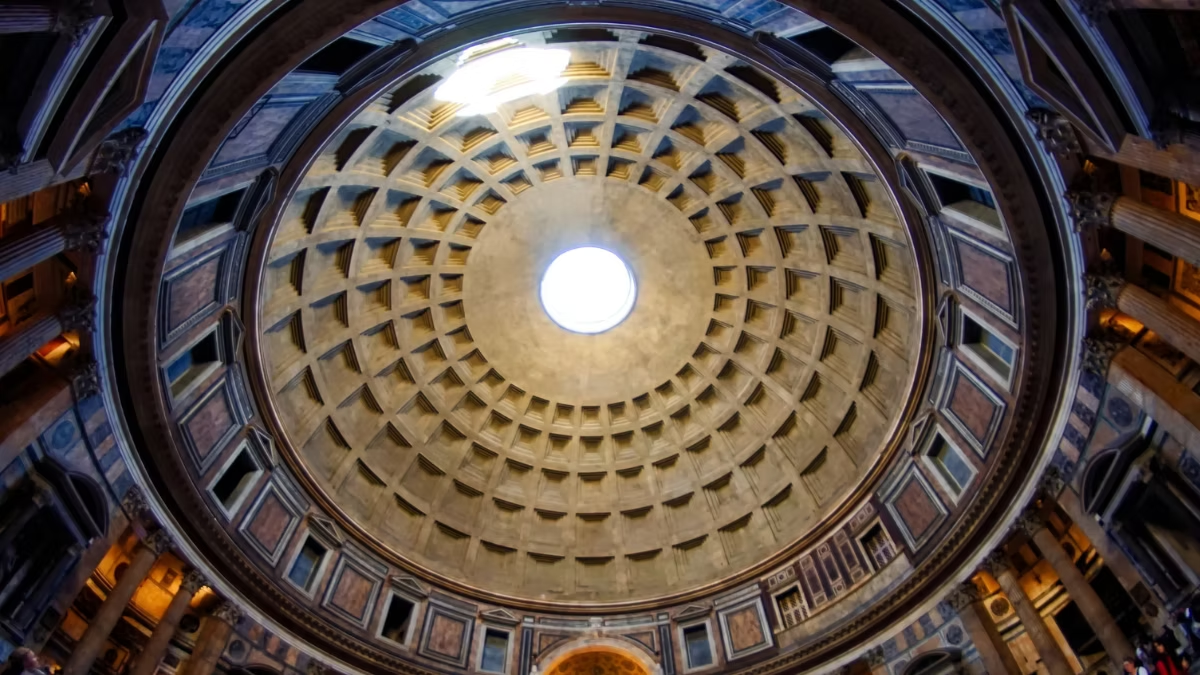
The Pantheon’s oculus is a circular opening 8.9 metres in diameter at the apex of the dome. It is open to the sky with no covering. It serves three purposes: structural (reducing weight at the dome’s most vulnerable point), practical (the building’s only natural light source), and symbolic (connecting the interior to the heavens). A beam of sunlight enters through the oculus and moves across the interior throughout the day. On 21 April at noon, the beam illuminates the Pantheon’s bronze entrance doors — an intentional solar alignment. When it rains, water falls through the opening and drains through holes in the floor.
The oculus — from the Latin for “eye” — is the single feature of the Pantheon that most visitors come specifically to see, and the one that generates the most questions. How can a building nearly two thousand years old have a hole in its roof and still stand? Why doesn’t it flood when it rains? Was the light alignment intentional? What does the beam do at different times of year?
This article answers all of those questions in full.
What Is the Oculus?
The oculus is a circular opening 8.9 metres in diameter at the exact centre of the Pantheon’s dome, open directly to the sky. It has no glass, grille, or covering of any kind. It is the building’s only source of natural light. The word oculus means “eye” in Latin.
The oculus sits at the apex of the dome, 43.3 metres above the floor — the same height as the dome’s diameter, creating the geometry of a perfect sphere within the rotunda. At the oculus rim, the dome’s thickness is approximately 1.2 metres, and the opening is reinforced with a stepped concrete ring that distributes the structural loads around its circumference.
The oculus is not glazed and never has been. You are looking directly at the sky. On clear days it frames a disc of blue. On overcast days the light is diffused and even. At night it frames a circle of stars. When it rains, water falls through it.
The Structural Function
The oculus solves the Pantheon’s most challenging engineering problem: how to build a 43-metre concrete dome without reinforcement. By removing concrete at the apex — the point of highest structural stress in a hemispherical shell — the oculus reduces both the weight and the stress concentration at the dome’s most vulnerable point. Without it, the dome would likely have cracked.
Building a dome of the Pantheon’s scale in unreinforced concrete requires managing enormous compressive forces that concentrate at the apex. In a solid hemisphere of this size, the crown would be the thinnest, most stressed point — and the most likely to fail. The oculus addresses this elegantly: by removing the concrete at the very point of highest stress, it eliminates the problem. The opening creates a compression ring at the rim that distributes loads around its circumference, rather than concentrating them at a single point.
The structural logic continues downward. The dome itself is not uniform concrete — it is graduated. At the base, the concrete contains heavy aggregate (basalt, travertine). As the dome rises, the aggregate becomes lighter (tufa, then pumice near the top). The 140 coffered panels in the dome’s interior surface further reduce weight by removing material from within the shell without weakening its structural integrity. The result is a dome that has survived nearly two thousand years of Roman earthquakes, floods, temperature cycles, and tourist visits without requiring reinforcement.
No engineer in the subsequent seventeen centuries produced an unreinforced concrete dome of this size. The record stood until the 20th century.
The Practical Function: Light
The oculus is the Pantheon’s only source of natural light. There are no windows in the drum wall. The building was designed to be illuminated entirely by this single circular opening.
The quality of light inside the Pantheon changes continuously throughout the day as the sun crosses the sky. In the morning, the beam enters at a low angle and strikes the western wall. By midday, as the sun climbs higher, the beam becomes more vertical and eventually points almost straight down toward the floor. In the afternoon, the beam shifts to the eastern side of the interior.
This moving light transforms the Pantheon into something like a living instrument — its interior constantly changing, never exactly the same from one hour to the next. On sunny days the beam is a crisp, sharply defined circle of light moving across the walls and floor. On cloudy days the diffused light from above creates a completely different atmosphere — even, soft, and contemplative.
The Symbolic Function
In a temple dedicated to all the gods, the oculus represented a literal opening to the divine realm. Roman cosmology understood the heavens as the domain of the gods; an opening at the building’s apex created a physical connection between the mortal interior and the divine exterior. The moving beam of light — tracking the sun’s passage — brought the cosmos into the building.
The Romans understood the heavens as a celestial sphere rotating around the earth, carrying the planets and stars in their courses. In a temple dedicated to all the gods, making the building’s geometry correspond to that celestial sphere — and opening a window at its apex for the sun to enter — was a statement of cosmic architecture. The Pantheon was not merely a building; it was a model of the universe, with the dome as the heavenly vault and the oculus as the connection point between the human world and the divine.
This symbolic interpretation is supported by the building’s other geometric quality: the interior sphere (the space that would be enclosed by a perfect ball fitting within the rotunda) is exactly the same size as the building’s diameter. Geometry as cosmology — the universe made physical in stone and concrete.
The Moving Light Beam
As the sun moves across the sky, the circular beam of light entering through the oculus tracks across the Pantheon’s interior walls and floor. The beam moves approximately one diameter’s width across the interior every two hours, covering the full circumference of the rotunda over the course of a day.
Morning (09:00–10:30): The sun is in the east; the beam enters at a low angle and strikes the western wall at about one-third height. The light is directional and dramatic, casting strong shadows from the coffered panels.
Late morning (10:30–12:00): The beam rises and begins to move toward the vertical. It passes across the upper walls on the western side.
Midday (12:00–13:00): The beam approaches its most vertical angle, pointing almost straight down toward the floor. This is when the light column is most visually dramatic — a shaft of sunlight descending from the sky into the centre of the building.
Afternoon (13:00–17:00): The beam shifts to the eastern side of the interior, tracking across the walls in the reverse of the morning pattern.
Late afternoon (17:00–19:00): The sun is low in the west; the beam strikes the eastern wall at a low angle, creating the same dramatic side-lighting effect as the morning in reverse.
The April 21 Phenomenon
On 21 April at noon — Rome’s traditional founding date — the midday beam through the oculus illuminates the Pantheon’s bronze entrance doors in a disc of golden light lasting approximately two minutes and fifty seconds. This solar alignment is believed to have been deliberately engineered by Hadrian’s architects as a piece of imperial theatre, designed so that an emperor arriving at precisely noon on Rome’s birthday would appear to be bathed in divine light.
Scholars Giulio Magli and Robert Hannah established in 2009 that the alignment is not accidental. The geometry of the Pantheon — specifically the relationship between the oculus diameter, the dome’s height, and the position of the entrance — produces the illumination of the doorway at this precise time and date. The beam size at noon on 21 April almost exactly matches the dimensions of the semicircular arch above the entrance.
The implication is theatrical. On the date Romans celebrated as the city’s founding — 21 April, 753 BC by ancient reckoning — the Pantheon was designed so that an emperor could walk through the entrance at precisely noon and be enveloped by a disc of light descending from the heavens. In a culture where emperors claimed divine descent or divine favour, this was not subtle: it was a visual statement that the gods endorsed the ruler’s arrival.
Magli and Hannah also identified alignments at the spring and autumn equinoxes, when the beam strikes specific architectural features in ways that appear deliberate, suggesting the Pantheon functioned as a kind of solar calendar — marking the sacred rhythm of the Roman year in light.
The Equinox Phenomena
At the spring and autumn equinoxes (around 20 March and 22 September), the oculus beam strikes the grille above the entrance at midday, creating a distinctive bright illumination of the doorway area. This alignment has led scholars to suggest that the Pantheon’s design incorporated multiple intentional solar events throughout the year — not just the April 21 founding-day alignment, but a broader programme of liturgical and agricultural calendar marking through light.
What Happens When It Rains
Water falls through the oculus when it rains. The floor is very slightly convex and has 22 drainage holes at its centre, connected to a Roman hydraulic drainage system beneath the floor that is still functional. Visitors may remain inside during rain. The effect — watching rain fall from the open sky into an ancient building and drain silently through holes in the floor — is one of the most extraordinary experiences the Pantheon offers.
A popular myth holds that it never rains inside the Pantheon, supposedly because warm air rising through the dome creates a chimney effect that deflects precipitation. This is not entirely true. Light rain and mist are sometimes deflected or dispersed by this upward air movement, but in any significant rainfall, water clearly falls through the oculus onto the marble floor.
When this happens, the drainage system — 22 small holes arranged in the centre of the floor’s slightly convex surface — channels the water into underground conduits. This system has been operational for nearly two thousand years. The sight of rain falling through the oculus in a visible column of water and then draining silently into the ancient floor is one of those experiences that makes the Pantheon’s continuity of function genuinely astonishing.
Staff do not close the Pantheon during rain. If your visit coincides with a thunderstorm, stay inside — the experience is worth it.
The Pentecost Rose Petal Ceremony
Once a year, during the Pentecost Mass, rose petals are dropped through the oculus from the roof above, falling in a cascade of red and pink through the opening into the interior below. This ceremony — unique in the world — commemorates the descent of the Holy Spirit at Pentecost and transforms the oculus from an architectural feature into a liturgical event. The Mass is open to worshippers; tourist entry is paused during the ceremony itself.
Best Times to See the Oculus
For morning light drama: Visit between 09:00 and 10:30. The low-angle beam strikes the western wall with striking directional force.
For the vertical midday column: Visit between 11:30 and 13:00, particularly around the summer solstice when the sun is at its highest.
For the April 21 alignment: Be inside at exactly noon on 21 April. Arrive early to secure a position in the rotunda before the midday influx.
For rain through the oculus: There is no predicting this, but if it rains during your visit, do not leave. Stay and watch.
For the Pentecost ceremony: The date changes each year (50 days after Easter). For an approximate date, calculate 50 days after Easter Sunday for the relevant year.
Frequently Asked Questions
How big is the oculus?
The oculus is 8.9 metres in diameter — roughly the width of a two-lane road.
Is the oculus covered with glass?
No. The oculus is open directly to the sky. There is no glass, grille, or covering of any kind.
Why doesn’t the Pantheon flood when it rains?
Because the floor is very slightly convex and has 22 drainage holes connected to an underground system. The water drains efficiently through a Roman hydraulic system that is still functional.
Can you see the sky through the oculus?
Yes. On clear days you see blue sky; on cloudy days the circle is white; at night you can see stars.
What is the oculus made of?
The oculus is an opening in the concrete dome, reinforced at its rim with a circular compression ring of concrete and brick. There is no material at the opening itself — it is simply a hole.
Does the beam of light actually touch the floor?
Near the solstices, when the sun is at its highest, the beam approaches close to vertical and does illuminate the floor around the central area. At other times of year, it strikes the walls at varying angles.
What time is best to see the oculus light beam?
Any time in clear sunshine will show the beam effect. The most dramatic is early morning (09:00–10:30), when the low-angle beam creates strong contrast on the western wall. For a near-vertical beam pointing toward the floor, come around midday, particularly near the summer solstice.
