
The History of the Pantheon: From Roman Temple to Christian Church
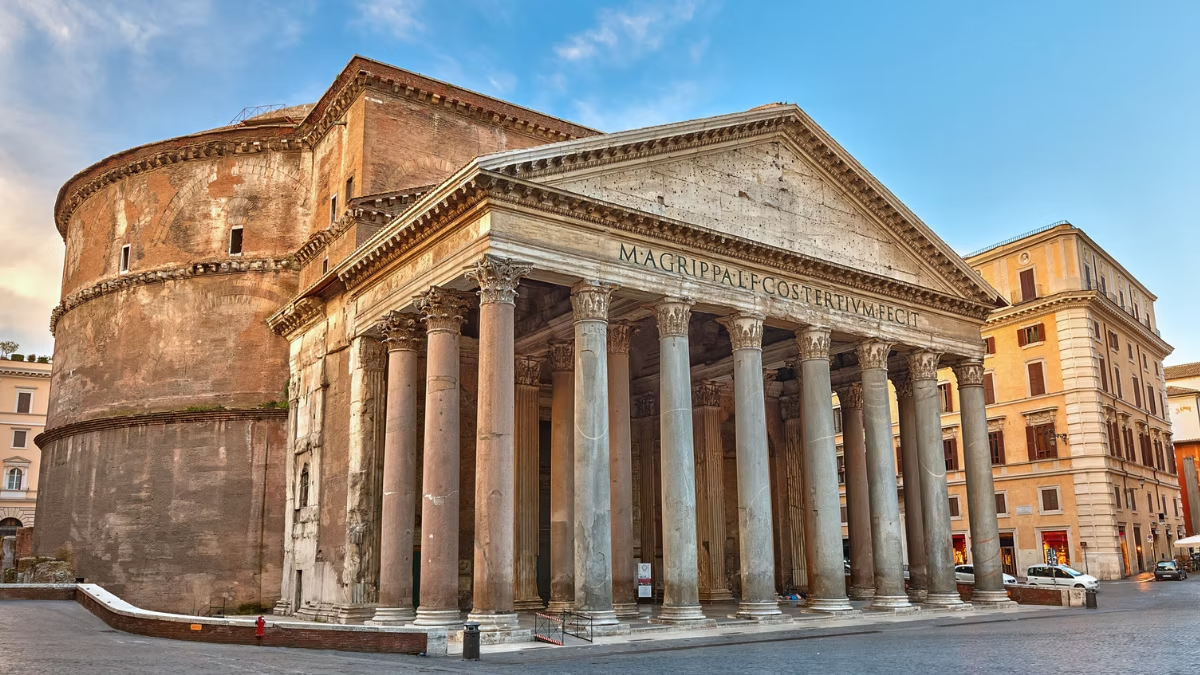
The Pantheon’s history spans nearly 2,000 years. The first building was commissioned by Marcus Agrippa in 27 BC. It burned down in 80 AD. A second version under Domitian also burned, around 110 AD. Emperor Hadrian built the current structure between approximately 113 and 125 AD, retaining Agrippa’s inscription on the portico. In 609 AD, Pope Boniface IV converted it to a Christian church — a decision that saved the building from the fate of virtually every other ancient Roman monument. It has been in continuous use ever since.
The Pantheon endures because each era found a new reason to preserve it. To Hadrian, it was an act of imperial piety and architectural ambition. To Pope Boniface IV, it was a trophy of Christian triumph over paganism. To Renaissance artists, it was a model of perfection and a worthy burial place. To the unified Italian state, it was a national mausoleum. To the nine million visitors a year who come today, it is the most complete encounter with the ancient Roman world that exists. This is the story of how a building built nearly two thousand years ago is still standing.
The First Pantheon: Agrippa’s Temple (27–25 BC)
The first Pantheon was commissioned by Marcus Vipsanius Agrippa — general, statesman, and son-in-law of Emperor Augustus — between 27 and 25 BC. It was a rectangular temple with a conventional Roman design, part of a larger building programme in the Campus Martius district of Rome. This building was destroyed by fire in 80 AD.
Marcus Vipsanius Agrippa was the most powerful figure in Rome after Augustus himself. He won the Battle of Actium in 31 BC — the naval victory that ended the Roman civil wars and established Augustus as sole ruler. As part of his own immense building programme in Rome’s Campus Martius (Field of Mars), Agrippa commissioned the Pantheon between 27 and 25 BC.
Agrippa’s original Pantheon was a rectangular structure with a conventional Greek-style portico — nothing like the revolutionary circular building that replaced it. The inscription that Hadrian would later preserve on the portico — “M·AGRIPPA·L·F·COS·TERTIVM·FECIT” — records that Agrippa built it as consul for the third time, placing the construction firmly in 27–25 BC.
What Agrippa’s temple looked like in detail remains unclear, because it was destroyed before any detailed description was made. Ancient sources tell us it was dedicated to the gods and contained statues of Julius Caesar (deified after his assassination) and possibly Augustus. In 80 AD, a catastrophic fire swept through the Campus Martius. Agrippa’s Pantheon was destroyed.
The Second Pantheon: Domitian’s Rebuilding (c. 80–110 AD)
Following the fire of 80 AD, Emperor Domitian ordered the Pantheon rebuilt. This second structure was also damaged — probably by lightning — around 110 AD, during the early years of Trajan’s reign. Like the first building, very little is known about it, and no above-ground remains survive.
Hadrian’s Pantheon: The Building We See Today (c. 113–125 AD)
Emperor Hadrian ordered the third and definitive Pantheon built, probably between 113 and 125 AD. He made the extraordinary decision to retain Agrippa’s inscription on the new portico, which caused centuries of confusion — historians long assumed they were looking at Agrippa’s original building. Brick stamps found during 19th-century excavations established that the current building dates entirely from Hadrian’s reign.
Emperor Hadrian (reigned 117–138 AD) was among the most cultured and architecturally ambitious rulers Rome ever produced. He rebuilt the Temple of Venus and Roma, constructed his famous wall across Britain, built Castel Sant’Angelo as his mausoleum, and commissioned the Villa Adriana at Tivoli. The Pantheon was his most enduring Roman project.
Rather than the conventional rectangular temple of Agrippa’s design, Hadrian’s architects created a circular domed rotunda unprecedented in scale and engineering ambition. The interior sphere of 43.3 metres diameter; the unreinforced concrete dome; the graduated aggregate mixing from heavy basalt at the base to light pumice at the crown; the oculus — all were Hadrian’s innovations, either directly or through his patronage.
Hadrian’s decision to retain Agrippa’s inscription on the portico has fascinated historians for centuries. He did this consistently with other buildings he rebuilt. Scholars interpret it as a deliberate act of political humility and continuity, associating his rebuilding programme with the prestige of the Augustan age rather than advertising his own name.
The Pantheon was probably dedicated around 125 AD, though the exact date is uncertain. Hadrian is believed to have held imperial audiences in the rotunda — using the building as both religious space and a venue for demonstrating imperial magnificence.
From Temple to Church: The Conversion of 609 AD
In 609 AD, Byzantine Emperor Phocas donated the Pantheon to Pope Boniface IV, who consecrated it as the Basilica of St. Mary and the Martyrs on 13 May 609. Twenty-eight cartloads of martyrs’ bones were moved from the catacombs to the building. This conversion almost certainly saved the Pantheon — religious status protected it from the stripping and abandonment that destroyed every other major pagan monument in Rome.
By the early 7th century, the Roman Empire in the West had collapsed and Rome’s population had fallen from over a million to perhaps 50,000. The great monuments of antiquity were being systematically stripped for building materials. Pope Boniface IV saw an opportunity — and possibly a theological necessity — in converting the Pantheon. By consecrating it as a Christian church, he simultaneously neutralised its pagan associations, claimed it for Christianity, and placed it under ecclesiastical protection at the moment when unprotected ancient buildings were being destroyed.
The consecration took place on 13 May 609 AD. The interior was stripped of its pagan cult images. Twenty-eight cartloads of sacred relics of martyrs were removed from the catacombs outside Rome and placed in a porphyry basin beneath the high altar. An icon of the Virgin Mary was installed. The building was renamed Sancta Maria ad Martyres — St. Mary and the Martyrs.
The conversion had exactly the protective effect Boniface must have hoped for. While the Forum’s temples were quarried to rubble and the Colosseum’s marble was stripped from its seating, the Pantheon was maintained and repaired throughout the Middle Ages under papal authority.
The Medieval Period (7th–15th Century)
Throughout the early medieval period, the Pantheon continued to function as a church. One significant loss occurred in 663 AD, when Byzantine Emperor Constans II visited Rome and ordered the gilded bronze tiles removed from the Pantheon’s exterior dome. These had given the exterior dome a gleaming golden appearance. They were shipped to Constantinople.
Throughout the Middle Ages, the Pantheon remained a functioning church, protecting it from neglect. In the Renaissance, it gained renewed attention as a symbol of classical architectural brilliance.
The Renaissance and the Tomb of Raphael (15th–16th Century)
The Renaissance brought renewed intellectual fascination with ancient Roman architecture, and the Pantheon was a central object of study. Brunelleschi studied it before designing the dome of Florence Cathedral. Michelangelo called it “the work of angels, not men.” Every significant architect of the period — Bramante, Palladio, Sangallo — measured and drew the Pantheon’s proportions, which then spread through architectural treatises across Europe.
The most significant event of this period was the burial of Raphael Sanzio in 1520. Raphael — the most celebrated painter of the High Renaissance — had expressed a wish to be buried in the Pantheon and had purchased a burial niche there. When he died on his 37th birthday on 6 April 1520, his request was granted. Pope Leo X reportedly wept. The burial elevated the Pantheon’s status from ancient monument to living cultural institution. For the full story, see our Raphael's Tomb guide.
The Barberini Despoliation (1625)
In 1625, Pope Urban VIII — born Maffeo Barberini — ordered the bronze ceiling of the Pantheon’s portico stripped and melted down. The bronze was used by Gian Lorenzo Bernini for the baldachin over the high altar at St. Peter’s Basilica and reportedly also for cannon at Castel Sant’Angelo.
The act caused immediate public outrage. Romans coined the phrase: “Quod non fecerunt barbari, fecerunt Barberini” — “What the barbarians did not do, the Barberini did.” Two bronze bell towers — nicknamed “the ass’s ears” — were added to the portico by Bernini at Urban VIII’s direction. They were mocked as aesthetically inappropriate and removed in 1883.
The Pantheon as Royal Mausoleum (19th–20th Century)
When Italy was unified under the House of Savoy in 1861, the first king — Victor Emmanuel II — chose the Pantheon as his burial place. He died in 1878 and was interred in the first niche on the right of the entrance. His son Umberto I (d. 1900) followed, along with Queen Margherita of Savoy. The presence of the Italian royal family reinforced the Pantheon’s status as the secular sacred space of the new Italian nation. For the full story, see our Kings of Italy at the Pantheon guide.
The Pantheon was designated a UNESCO World Heritage Site as part of the Historic Centre of Rome in 1980.
The Introduction of Entry Fees (2023 to Present)
On 3 July 2023, the Italian Ministry of Culture introduced a €5 entry fee for adult visitors, with the introduction of a timed entry system via the Musei Italiani portal. Pre-booking became effectively essential in peak season. For full details on current tickets and entry, see our Pantheon Tickets guide.
Historical Timeline
| Date | Event |
|---|---|
| 27–25 BC | Marcus Agrippa commissions the first Pantheon |
| 80 AD | Fire destroys Agrippa's Pantheon |
| c. 80–110 AD | Domitian's second Pantheon built and damaged |
| c. 113–125 AD | Hadrian builds the current Pantheon |
| 125 AD | Probable dedication of Hadrian's Pantheon |
| 609 AD | Pope Boniface IV consecrates it as a Christian church |
| 663 AD | Byzantine Emperor Constans II strips the gilded bronze dome tiles |
| 1520 | Raphael buried in the Pantheon |
| 1625 | Pope Urban VIII strips the portico bronze; Barberini controversy |
| 1878 | Victor Emmanuel II buried in the Pantheon |
| 1883 | Bernini's bell towers removed during Italian unification renovation |
| 1980 | UNESCO World Heritage Site designation |
| 2023 | €5 entry fee introduced; timed entry system launched |
Frequently Asked Questions
Who originally built the Pantheon?
The first Pantheon was commissioned by Marcus Agrippa in 27–25 BC. The current building was constructed by Emperor Hadrian between approximately 113 and 125 AD — he retained Agrippa’s inscription on the portico, causing centuries of historical confusion.
Why did the Pantheon survive when other ancient Roman buildings didn’t?
Primarily because Pope Boniface IV converted it to a Christian church in 609 AD, placing it under papal protection at the moment when unprotected pagan monuments were being systematically stripped and demolished.
When was the Pantheon converted to a church?
13 May 609 AD, by Pope Boniface IV, who renamed it Sancta Maria ad Martyres (St. Mary and the Martyrs).
Who is buried in the Pantheon?
Raphael (1483–1520), Victor Emmanuel II (1820–1878), Umberto I (1844–1900), Queen Margherita of Savoy (1851–1926), and several other artists and architects. For the full story, see our Who Is Buried in the Pantheon guide.
What is the “Barberini” phrase about?
“Quod non fecerunt barbari, fecerunt Barberini” — “What the barbarians did not do, the Barberini did” — refers to Pope Urban VIII’s 1625 order to strip the bronze portico ceiling, widely regarded as an act of vandalism against an ancient monument.
