
Pantheon to Piazza Navona: Walking Route & What to See
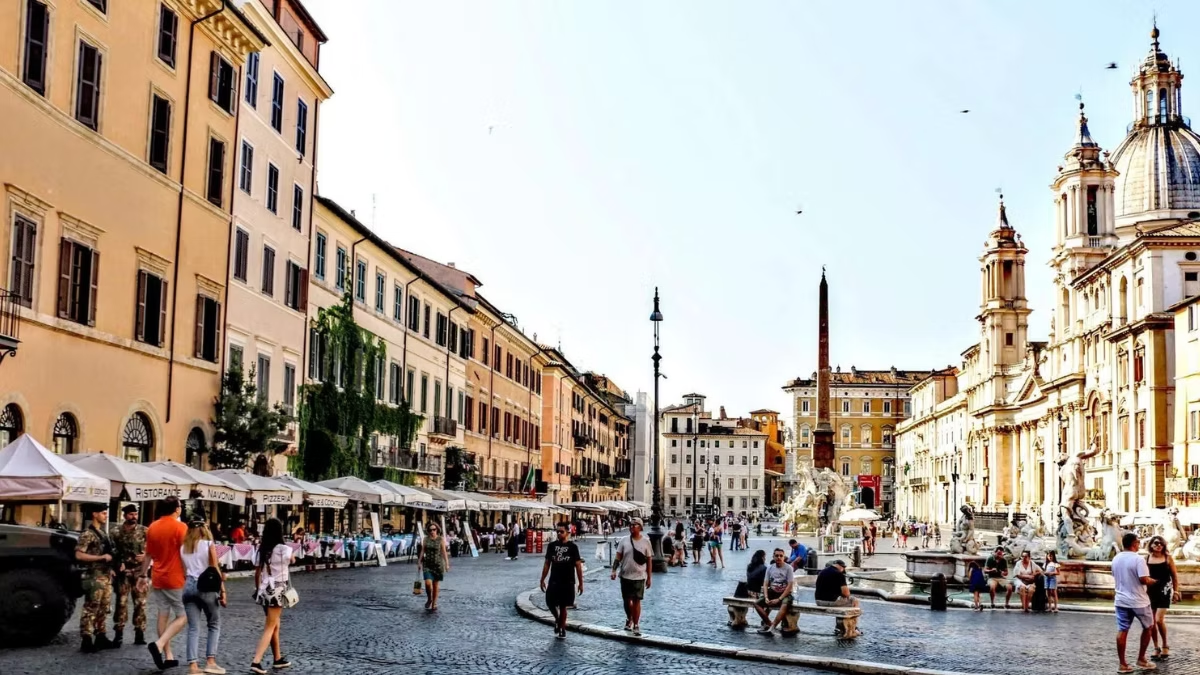
The Pantheon and Piazza Navona are approximately 300 metres apart — a 4–5 minute walk through the narrow streets of Rome’s historic centre. The route is direct and entirely pedestrianised. The most straightforward path exits Piazza della Rotonda to the west and follows Via della Palombella to Piazza Navona’s southern entrance.
The Pantheon and Piazza Navona are the two most visited landmarks in Rome’s historic centre, and at 300 metres apart they are also the closest major sights to each other in the city. Whether you are walking from one to the other or planning a broader day in the historic centre, this guide gives you the direct route, highlights worth noticing along the way, and a brief introduction to what you will find at Piazza Navona.
The Walking Route: Step by Step
Total distance: approximately 300 metres Walking time: 4–5 minutes at a normal pace Terrain: Cobblestone streets, entirely pedestrianised
Step 1: Exit the Pantheon through the main bronze doors and cross Piazza della Rotonda. With your back to the Pantheon entrance, walk to the left (west) across the piazza.
Step 2: Take Via della Palombella — the street that runs west-northwest from the piazza’s left edge. This short lane is lined with small bars, souvenir shops, and at lunchtime, the scent of nearby restaurants.
Step 3: Via della Palombella ends directly at the southern end of Piazza Navona, arriving between the Fontana del Moro (the southern fountain) and the main central axis of the piazza. You are now in Piazza Navona.
That is the direct route. The entire walk takes under five minutes and involves no junctions, no traffic crossings, and no navigation complexity.
An Alternative Route: Via Sant’Agnese in Agone
A slightly longer but more architecturally interesting route (7–8 minutes) exits the Pantheon piazza to the northwest via Via del Salvatore, passes the small church of Sant’Agostino (containing Caravaggio’s Madonna of the Pilgrims), and arrives at Piazza Navona’s northern end. This gives you a view of the full length of the piazza as you approach — one of the best first impressions in Rome.
What to Notice En Route
The walk between the Pantheon and Piazza Navona is short enough that most visitors simply move through it, but the streets contain details worth slowing down for:
The medieval street layout: The lanes between the Pantheon and Piazza Navona follow the medieval street pattern that developed on top of the ancient Campus Martius. The width and irregularity of the streets reflect 1,500 years of organic urban growth rather than planning.
Palazzo Braschi: On the corner approaching Piazza Navona from the south, the imposing neoclassical Palazzo Braschi (now the Museo di Roma) marks the southern approach to the piazza. Its scale gives a sense of the institutional prestige that the area has always carried.
What to See at Piazza Navona
Piazza Navona is built on the footprint of the ancient Stadium of Domitian (1st century AD), which seated 30,000 spectators. The stadium’s elongated oval outline is perfectly preserved in the piazza’s form. The buildings that ring the piazza sit directly on the stadium’s ancient seating banks — if you look at the basement levels of the surrounding buildings, in some cases you can see ancient masonry incorporated into their foundations.
The Fountain of the Four Rivers (Fontana dei Quattro Fiumi): The centrepiece of Piazza Navona, designed by Gian Lorenzo Bernini and unveiled in 1651. Four colossal river gods — each representing one of the world’s great rivers as known to 17th-century geography — surround an ancient Egyptian obelisk: the Nile (Africa, with veiled face because its source was unknown), the Danube (Europe), the Ganges (Asia), and the Río de la Plata (the Americas). The figures are among Bernini’s most celebrated sculptures, full of dynamic movement and baroque energy.
Sant’Agnese in Agone: The church on the western side of the piazza, whose curved façade was designed by Francesco Borromini — Bernini’s great rival and architectural nemesis. The traditional story that Bernini’s Río de la Plata figure raises its hand in horror at the sight of Borromini’s church, and that the Nile covers its face to avoid looking at it, is almost certainly apocryphal — the fountain predates the church’s façade — but the rivalry between the two architects was real and bitter.
The Fontana del Moro: The southern fountain of the piazza, featuring a Moor figure wrestling a dolphin. Originally designed by Giacomo della Porta in 1576, the central figure was added by Bernini in 1653.
The atmosphere: Piazza Navona is at its best in the evening, when the cafés fill up, the buskers set up, and the baroque monuments are lit from below. It is busy at any hour in high season, but after 19:00 it transitions from tourist spectacle to genuinely Roman evening gathering place.
Combining the Pantheon and Piazza Navona in Your Itinerary
These two landmarks are natural companions on any historic centre itinerary. There are two logical orderings:
Piazza Navona first, then the Pantheon: Gives you the Pantheon as a culmination — arriving from the northwest at the Pantheon entrance after walking through the ancient city. The transition from baroque to ancient is stark and effective.
Pantheon first, then Piazza Navona: Works well if you have a morning Pantheon slot — you exit the Pantheon, walk five minutes to Piazza Navona, spend 20–30 minutes, and then continue to other landmarks. This is the more natural walking direction if you are heading onward to Campo de’ Fiori or Trastevere.
For a full half-day itinerary combining these two landmarks with the Trevi Fountain and other nearby sites, see our Half-Day Itinerary guide.
Frequently Asked Questions
How far is it from the Pantheon to Piazza Navona?
Approximately 300 metres — a 4–5 minute walk.
Can you walk from the Pantheon to Piazza Navona?
Yes, entirely on foot through pedestrianised streets. No transport is needed or practical for this distance.
What is the best route from the Pantheon to Piazza Navona?
The most direct route exits Piazza della Rotonda to the west and follows Via della Palombella directly to Piazza Navona’s southern entrance — about 4 minutes. For a slightly longer but more architecturally interesting approach, go via Via del Salvatore to arrive at the northern end and walk the full length of the piazza.
Is Piazza Navona worth visiting?
Yes — it is one of the finest baroque public spaces in Europe. Bernini’s Fountain of the Four Rivers alone justifies the five-minute detour from the Pantheon. The best time to visit is early morning (before 10:00) or evening (after 19:00) when crowds are thinner.
