
The Pantheon Building: An Introduction
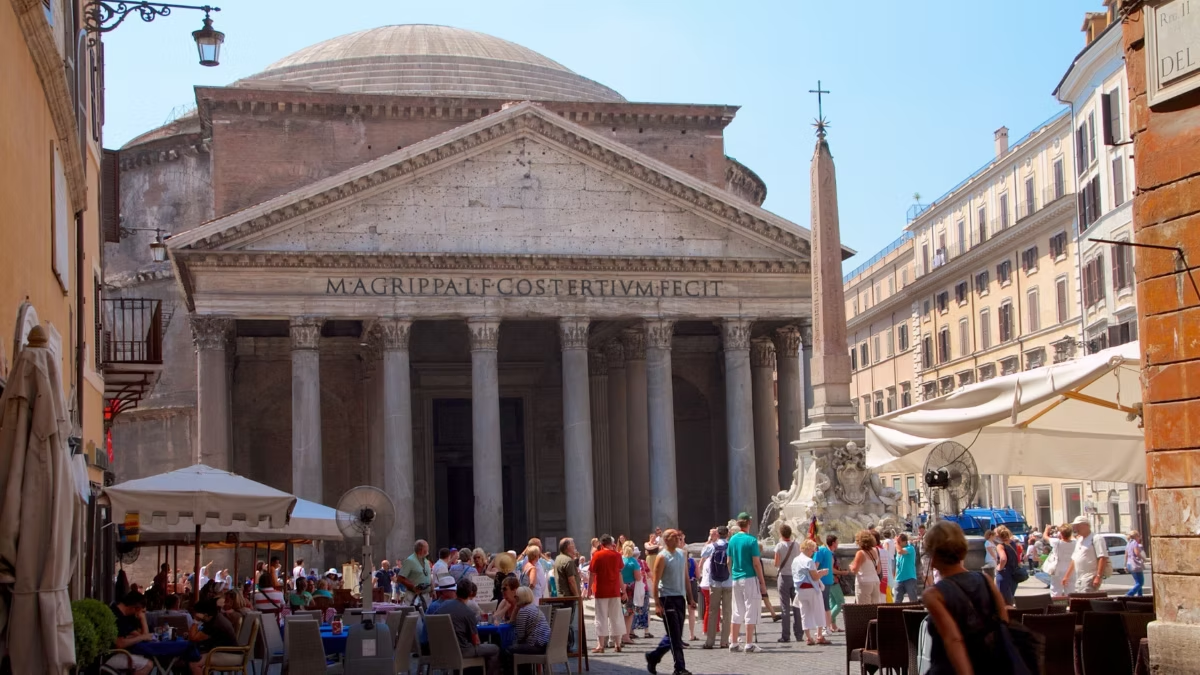
The Pantheon is a nearly 1,900-year-old Roman temple converted to a Catholic church in 609 AD, located at Piazza della Rotonda in Rome’s historic centre. It is the best-preserved ancient building in the world. The exterior combines a classical Greek-style portico — 16 granite columns 11.8 metres tall, weighing 60 tonnes each — with a massive cylindrical rotunda topped by the world’s largest unreinforced concrete dome (43.3 metres diameter). The bronze doors are the oldest surviving in Rome. The building has been in continuous use for nearly two millennia.
Standing in Piazza della Rotonda and looking at the Pantheon for the first time, visitors often feel that something is not quite right. The building seems almost too complete — too undamaged for something nearly 1,900 years old. Every other major ancient Roman monument is a ruin. The Forum is a field of broken columns. The Colosseum is a shell. The Pantheon alone stands intact, its dome unbroken, its columns uncracked, its bronze doors still swinging on their original pivots. Understanding how this happened — and what you are actually looking at — transforms a visit from a standard sightseeing stop into something genuinely extraordinary.
What Is the Pantheon?
The Pantheon (full name: Basilica di Santa Maria ad Martyres) is a Roman temple built by Emperor Hadrian around 125 AD on the site of two earlier temples. It was converted to a Christian church in 609 AD. It is the best-preserved building from ancient Rome, has been in continuous use for nearly two millennia, and holds the world’s largest unreinforced concrete dome.
The Pantheon’s name comes from the Greek pan (all) and theos (gods) — it was originally a temple dedicated to all the gods of Rome. The exact gods worshipped there is debated; what is certain is that it was a major religious building in the heart of ancient Rome’s most prestigious civic district, the Campus Martius.
Today it functions as the Basilica di Santa Maria ad Martyres — a Catholic church dedicated to the Virgin Mary and the Christian martyrs — and remains an active place of worship. It is also a royal mausoleum, containing the tombs of Raphael and the first two kings of unified Italy.
A Brief History of the Building
The Three Pantheons
The current Pantheon is actually the third building on this site. The first was commissioned by the Roman statesman Marcus Vipsanius Agrippa between 27 and 25 BC, during the reign of Augustus. This original structure was largely destroyed by fire in 80 AD.
A second building was erected under Emperor Domitian shortly after, but this too was badly damaged — possibly by lightning — around 110 AD.
Emperor Hadrian commissioned the definitive structure we see today, with construction estimated to have taken place between approximately 113 and 125 AD. In one of history’s most unusual acts of architectural modesty, Hadrian chose to retain Agrippa’s original inscription on the portico — “M·AGRIPPA·L·F·COS·TERTIVM·FECIT” (Marcus Agrippa, son of Lucius, three times consul, built this) — rather than replacing it with his own name. This inscription caused centuries of confusion among later visitors, who assumed Agrippa’s original building was the one they were looking at.
Conversion to a Christian Church
In 609 AD, the Byzantine Emperor Phocas donated the Pantheon to Pope Boniface IV, who consecrated it as a Christian church. This single act of religious repurposing almost certainly saved the building. Throughout the Middle Ages, virtually every major pagan monument in Rome was stripped for materials — marble, bronze, travertine — to build new structures. The Pantheon’s status as a consecrated church placed it under ecclesiastical protection, and its fabric was largely preserved.
Even so, the building did not escape entirely unscathed. In 1625, Pope Urban VIII (of the Barberini family) ordered the bronze roofing of the portico to be stripped and melted down, reportedly to provide material for Bernini’s baldachin at St. Peter’s Basilica and for Castel Sant’Angelo’s cannons. Romans were furious — giving rise to the famous phrase: “Quod non fecerunt barbari, fecerunt Barberini” (“What the barbarians did not do, the Barberini did”).
The Exterior: What You See from Piazza della Rotonda
The Piazza
Approaching the Pantheon from the surrounding streets, visitors step down from the modern street level into the piazza. This step downward is not a design feature — it reflects the fact that Rome’s street level has risen by several metres over two thousand years of accumulated debris, rubble, and building. The Pantheon sits in a shallow depression relative to its surroundings, as if it has slowly sunk into the city’s past.
The Fontana del Pantheon at the centre of the piazza was designed by Giacomo della Porta in 1575, with the Egyptian obelisk added by Pope Clement XI in 1711. The obelisk originally stood at the nearby Temple of Isis.
The Portico
The Pantheon’s front face is a classical Greek-style portico — a deep entrance porch supported by sixteen Corinthian columns arranged in four rows. The eight front columns support a triangular pediment; the remaining eight are arranged behind in two rows of four, creating three aisles through the porch.
The columns are monolithic — each shaft is cut from a single piece of stone, with no joints. They are made from Egyptian grey granite from the quarries at Mons Claudianus in the eastern Egyptian desert, and from rose-pink Aswan granite for the interior columns. Each column is 11.8 metres tall, 1.5 metres in diameter, and weighs approximately 60 tonnes. The capitals and bases are carved from white Greek marble from Mount Pentelicus near Athens — the same quarry that supplied material for the Parthenon.
Transporting these columns from Egypt to Rome involved quarrying, hauling across desert to the Nile by wooden sledge, barging down the Nile, sea transport across the Mediterranean, and then moving overland through Rome to the building site. It was one of the great logistical feats of the ancient world.
The pediment above the columns bears Agrippa’s inscription. It originally also featured a decorative bronze relief, which is now lost. The triangular pediment was once framed by bronze roof tiles, removed in 663 AD on the orders of the Byzantine Emperor Constans II.
The Bronze Doors
The Pantheon’s entrance doors are among the most remarkable features of the exterior that visitors walk through without fully registering. They are approximately 7 metres tall, weigh around 20 tonnes, and are the oldest surviving bronze doors in Rome. They have hinged and swung on the same bronze pivots for nearly 1,900 years without significant repair.
The design of the doors — coffers and mouldings arranged in a pattern that echoes the interior geometry of the dome — was not accidental. The doors function as an architectural introduction to the space beyond: the visitor’s eye is primed for the coffered interior before entering.
The Rotunda
From the exterior, the drum of the rotunda rises behind the portico. The cylindrical wall is approximately 6 metres thick at the base — a thickness that carries the enormous weight of the dome above without buttressing. The external surface of the drum was originally covered with white marble veneer (long since stripped) and is now exposed Roman brick and concrete.
From ground level in the piazza, the dome is largely invisible behind the drum wall — a deliberate design choice. The building presents a conventional temple face to the visitor and then reveals its revolutionary interior only once you have passed through the bronze doors.
The Dome: Seen from Outside
The dome of the Pantheon is visible from a distance across Rome but is most often seen from ground level in the piazza, where only the upper section projects above the drum wall. From elevated vantage points — the roof of the nearby church of Santa Maria sopra Minerva, or from across the city — the full scale of the dome becomes apparent.
The dome’s exterior is divided into five stepped rings that reduce in height toward the oculus, creating the visual effect of a stepped pyramid from above. This stepped exterior reduces the dome’s weight progressively toward the top. The oculus opening — 8.9 metres in diameter — is visible at the apex.
The exterior of the dome was originally covered in gilded bronze sheets, which were removed by Emperor Constans II in 663 AD and sent to Constantinople. The current exposed concrete surface dates largely from this stripping, though various restorations have taken place over the centuries.
Why Does the Pantheon Still Stand?
The survival of the Pantheon — intact, while every other major ancient Roman structure is in ruins — is the result of a specific combination of factors:
Religious conversion: The 609 AD consecration as a Christian church placed the building under papal protection at the precise moment when other pagan monuments were being systematically stripped.
Engineering: The dome’s design — using lighter pumice and volcanic ash concrete near the top, the oculus reducing weight at the apex, the 6-metre-thick walls distributing loads — created a structure that has remained in equilibrium for nearly two millennia without reinforcement.
Continuity of use: The Pantheon has never been abandoned. Continuous occupation means it has always had people motivated to maintain and repair it, rather than simply quarrying it for building material.
Geography: Located in the populated centre of Rome rather than on the city’s periphery, the Pantheon was never isolated enough to be used as a convenient quarry without social consequence.
Practical Information
The Pantheon is located at Piazza della Rotonda, 00186 Roma. Entry requires a pre-booked timed ticket (€5 for adults, free for under-18s). For all entry options, see our Pantheon Tickets guide. For directions, see How to Get to the Pantheon. For opening hours, see our Opening Hours guide.
Frequently Asked Questions
What is the Pantheon made of?
The dome is made of Roman concrete (opus caementicium) with decreasing density toward the apex — heavier basalt and travertine at the base, lighter tufa and pumice higher up. The walls are brick and concrete. The exterior columns are Egyptian granite; the capitals are Greek marble.
Why is the Pantheon called the Pantheon?
From the Greek pan (all) and theos (gods). The building was originally dedicated to all the Roman gods, though the precise nature of worship there is still debated by scholars.
How old is the Pantheon?
The current building was completed around 125 AD, making it approximately 1,900 years old. The site has been built on since 27 BC.
How tall is the Pantheon?
The interior height from floor to the centre of the oculus is 43.3 metres — equal to the dome’s diameter, creating the geometry of a perfect sphere within the rotunda.
Why did the Pantheon survive when other Roman buildings didn’t?
Primarily because it was converted to a Christian church in 609 AD, protecting it from the systematic stripping of materials that destroyed virtually every other ancient Roman monument.
