
The Architecture of the Pantheon: How It Was Built & Why It Still Stands
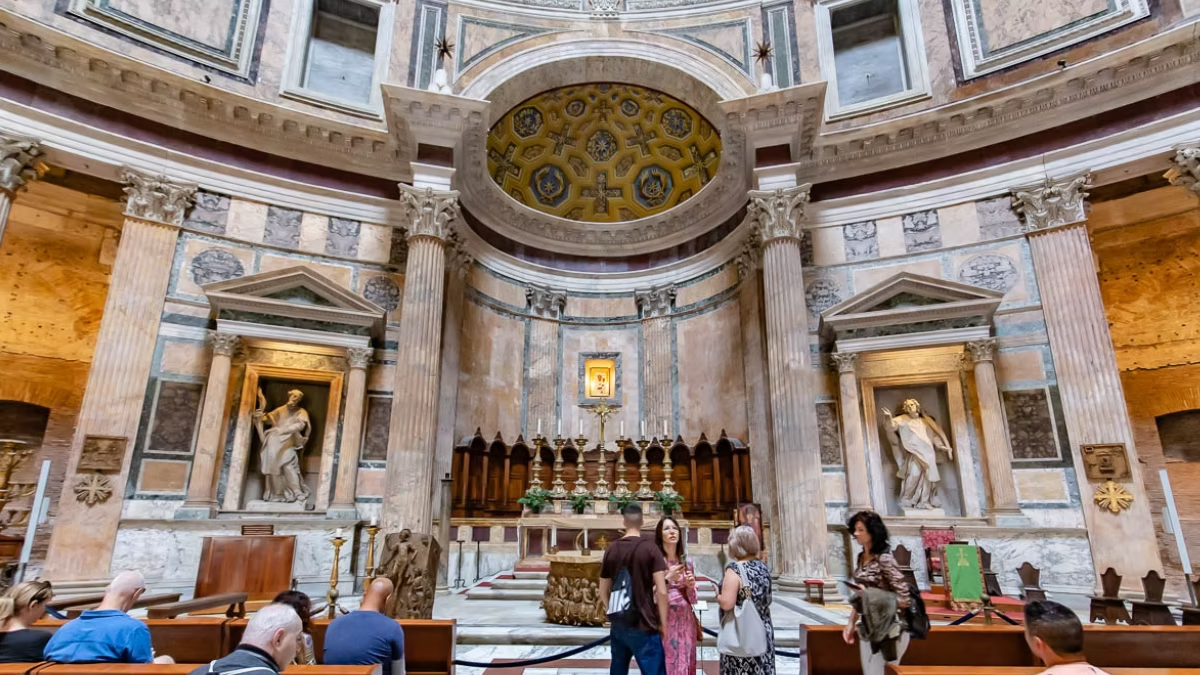
The Pantheon combines a classical rectangular Greek portico with a revolutionary circular domed rotunda. The dome — 43.3 metres diameter, the world’s largest unreinforced concrete dome — was cast from opus caementicium (Roman concrete) using a graduated mixture that becomes lighter toward the oculus. The walls are 6 metres thick at the base, contain concealed brick vaults and relieving arches, and distribute the dome’s weight to the foundations. No one has reproduced an unreinforced concrete dome of this scale since. The engineering remains incompletely understood.
The Pantheon is the most architecturally influential building in the Western world. Brunelleschi studied it before designing the Florence Cathedral dome. Michelangelo called its proportions divine. Palladio measured every column and reproduced its ratios in country villas across the Veneto. Thomas Jefferson referenced it in designing the University of Virginia’s Rotunda. The United States Capitol, the Panthéon in Paris, the Radcliffe Camera in Oxford — all are Pantheon descendants. None of them is built the same way. This article explains how the original was actually constructed — and why the method has never been replicated.
The Two Architectural Elements
The Pantheon combines two distinct architectural traditions that had never previously been united at this scale:
The portico: A classical Greek temple front — eight massive Corinthian columns supporting a triangular pediment, with two groups of four columns arranged behind. This element follows conventional Roman temple architecture of the period, providing a familiar, legible face to the building and creating no expectation of what lies beyond.
The rotunda: A circular domed interior with no precedent in Roman architecture at this scale. The transition from the rectangular portico to the circular rotunda is managed through a rectangular intermediate vestibule. The visitor moves from the rational, rectilinear world of the portico into the spherical world of the rotunda without any external indication that such a transition is coming.
This disjunction — the deliberate concealment of the rotunda behind a conventional temple front — was almost certainly intentional. The surprise of the interior is part of the architectural experience. The building seems designed to deceive from outside and astonish from within.
Roman Concrete: Opus Caementicium
The Pantheon’s dome is built from opus caementicium — Roman concrete — composed of volcanic ash (pozzolana), lime, and aggregate stone. This material sets harder than ordinary lime mortar and is waterproof. The specific formula used in the Pantheon’s dome has not been fully replicated, and modern engineers still study its composition and durability.
Roman concrete (opus caementicium) was made from:
Pozzolana: Volcanic ash found in large quantities around Rome. When mixed with lime and water, pozzolana produces a hydraulic cement that sets hard even underwater.
Lime: Burned limestone, which reacts with the pozzolana to form calcium silicate hydrates — the binding matrix of the concrete.
Aggregate: Stones mixed into the concrete to provide bulk and strength. The type of aggregate varied depending on the structural requirements at each level of the building.
The Pantheon’s concrete was not poured in the modern sense — it was laid in courses, with aggregate stones placed by hand into the wet mortar mix layer by layer. Modern material scientists studying the Pantheon’s concrete have found that over centuries, the material has continued to mineralise — actually strengthening over time rather than degrading. This is the opposite of what happens with most modern concrete. The volcanic ash in the Roman mix appears to be responsible for this unusual long-term behaviour.
The Dome: Graduated Aggregate
The dome is cast in rings of concrete with progressively lighter aggregate as the rings rise toward the oculus. The bottom ring uses dense basalt and travertine. The middle rings use tufa (lighter volcanic stone). The rings nearest the oculus use pumice — the lightest available Roman aggregate. This graduated weight distribution was the key structural innovation that made the dome possible.
Building a dome of 43.3 metres in unreinforced concrete requires managing the compressive forces that build up within the shell as it curves toward the apex. The Pantheon’s architects addressed this through two complementary strategies:
Graduated aggregate: The concrete becomes lighter as the dome rises. The change is stepped — different aggregate mixtures were used in successive horizontal bands. Near the base, the aggregate is heavy travertine and basalt; near the top, light pumice. The total weight reduction achieved by this graduation has been estimated at approximately 5,000 tonnes compared with a uniform-mix dome of the same dimensions.
The coffered panels: The 140 square recesses (coffers) visible in the interior of the dome are not merely decorative. Each coffer removes material from within the dome’s shell, reducing total mass without reducing structural cross-section significantly. The coffers are arranged in five rings that diminish in size as they approach the oculus — each ring has 28 coffers. The visual effect makes the dome appear lighter and higher than it physically is; the structural effect is meaningful weight reduction.
The oculus: The opening at the apex removes concrete from exactly the point of highest compressive stress in a hemispherical shell. Rather than being the dome’s structural weakness, the oculus is its structural solution — the compression ring at the oculus rim distributes the forces around the opening rather than concentrating them at a single point.
The Walls: 6 Metres of Hidden Engineering
The cylindrical drum wall of the Pantheon is approximately 6 metres thick at the base. This thickness is not simply mass — it contains a sophisticated internal structure invisible from inside the building.
Concealed niches: Seven large semicircular recesses in the inner wall surface (the niches visible from inside) reduce the wall’s mass while leaving the outer shell and the structural columns between niches intact. The wall is not a solid ring — it is eight massive piers connected by curved vaults.
Brick relieving arches: Built within the concrete of the walls are brick arches that redirect the dome’s downward and outward thrust to specific structural pillars rather than distributing it evenly across the full wall circumference. These arches are invisible from inside but visible in the building’s exterior brick course in some areas. They function as a secondary structural system within the primary concrete mass.
Stepped external rings: The exterior of the drum shows three stepped ledges at different heights. These are not decorative — they distribute the dome’s load progressively to the foundations, creating a hierarchy of structural elements that carries the weight efficiently to the ground.
The Foundations
The Pantheon sits on ring foundations approximately 4.7 metres deep and 7.3 metres wide, consisting of concrete laid with travertine aggregate. During Hadrian’s construction, the foundations cracked due to the unstable clay soil beneath the Campus Martius. A second reinforcing foundation ring was built, projecting 3 metres beyond the original perimeter, and additional buttress walls were constructed on the south side of the building.
The depth of the Pantheon below its surroundings — the step down from Piazza della Rotonda into the portico — reflects not only the rise of Rome’s street level over two millennia but also the depth of this foundation system, which projects significantly below the ancient Roman street level.
The Intermediate Space: Vestibule and Transition
Between the portico and the rotunda lies a rectangular intermediate space that manages the transition from the rectangular geometry of the portico to the circular geometry of the rotunda. This space contains the bronze doors and creates a brief moment of compression before the rotunda opens above the visitor.
The architectural effect of this transition is calculated. Entering through the doors into a space with a lower, visible ceiling, then stepping forward to where the full height of the dome becomes apparent — this is not accidental staging. The intermediate space makes the rotunda’s scale more shocking precisely by withholding it for a moment.
The Portico Columns: Logistics as Architecture
The 16 Corinthian columns of the portico are each cut from a single piece of stone — monoliths. The eight front columns are Egyptian grey granite from the quarries at Mons Claudianus in the eastern Egyptian desert. The eight interior columns are pink Aswan granite. Each column is 11.8 metres tall, 1.5 metres in diameter, and weighs approximately 60 tonnes.
Quarrying, transporting to the Nile on wooden sledges, barging downriver, shipping across the Mediterranean, unloading at Ostia, transporting up the Tiber by barge, and hauling through the streets of Rome to the Campus Martius — these columns represent a logistical achievement that shaped the building as much as any purely architectural decision.
Architectural Legacy
No building constructed after the Pantheon has reproduced its specific structural approach — the unreinforced concrete dome of this scale. Every subsequent large dome (Brunelleschi’s Florence Cathedral, Michelangelo’s St. Peter’s, Wren’s St. Paul’s, Soufflot’s Paris Panthéon) uses different structural strategies — ribbed masonry, hidden iron chains, timber frameworks — because the Roman concrete technique was not replicated in Europe after the fall of the Western Empire.
The Pantheon influenced architecture primarily through its spatial concept — the circular domed room as a paradigm of perfect proportion — rather than through its construction method. Designers copied the idea; they could not copy the engineering.
Frequently Asked Questions
What type of concrete is the Pantheon dome made from?
Opus caementicium — Roman concrete made from volcanic ash (pozzolana), lime, and aggregate stones. The aggregate changes from heavy basalt at the base to light pumice near the oculus, reducing the dome’s weight toward the top.
How thick are the Pantheon walls?
Approximately 6 metres at the base. The walls contain concealed brick arches and internal niches that reduce mass while maintaining structural integrity.
Why hasn’t anyone built another dome like the Pantheon’s?
The Roman concrete technique — using volcanic ash pozzolana — was lost after the fall of the Western Empire. Subsequent architects used different structural strategies for large domes. The formula was only partially rediscovered by modern materials scientists studying the Pantheon itself.
How was the dome built without modern cranes?
On a temporary wooden support structure (centring) assembled inside the rotunda and removed after the concrete had set. The exact geometry of the centring and the construction sequence are debated, but the use of temporary formwork is established.
Why does the dome not crack?
Multiple reasons: the graduated aggregate reduces stress concentrations; the oculus removes material from the highest-stress point; the concealed brick arches redistribute loads; and the Roman concrete’s unusual long-term mineralisation actually strengthens the material over time rather than degrading it.
