
Who Is Buried in the Pantheon?
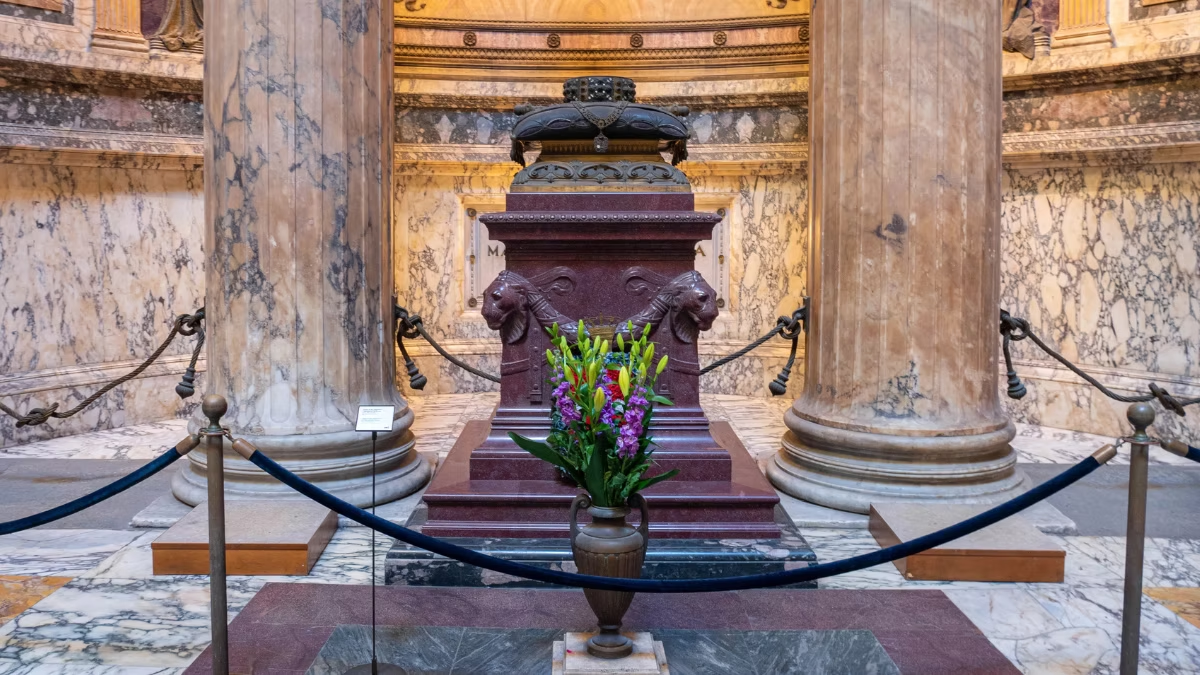
The Pantheon contains the tombs of Raphael (third niche on the left), Victor Emmanuel II — first king of unified Italy (second niche on the right), Umberto I and Queen Margherita of Savoy (first niche on the right), plus the artists Annibale Carracci, Baldassare Peruzzi, and Arcangelo Corelli, among others. Ancient Romans did not bury their dead inside temples; the Pantheon only became a burial site after its conversion to a Christian church in 609 AD.
The Pantheon was not designed as a burial place. When Emperor Hadrian built it in the 2nd century AD, Roman religious law prohibited burials inside the city walls, let alone inside temples. The building became a mausoleum almost by accident — a consequence of its conversion to a Christian church in 609 AD. Once it was a church, burials became possible, and over the following centuries, an extraordinary sequence of individuals chose — or were chosen — to be interred within its walls. This guide covers every significant burial, where to find each tomb inside the building, and why the choice of the Pantheon as a resting place carried such weight.
How the Pantheon Became a Burial Site
The Pantheon’s transformation from temple to mausoleum followed directly from its conversion to a Christian church on 13 May 609 AD. Pope Boniface IV consecrated it as the Basilica di Santa Maria ad Martyres and transferred the remains of numerous Christian martyrs from the catacombs outside Rome into the building. This act established the building’s identity as a place that could hold mortal remains.
From the Renaissance onwards, the Pantheon’s status as the most complete surviving monument from ancient Rome made it an intensely desirable burial site for the greatest figures of Italian culture. Being buried here was not merely an honour — it was a statement that you belonged among the permanent foundations of civilisation itself. Raphael understood this when he purchased his burial niche in advance. The unified Italian state understood it when it buried its first two kings here instead of the dynastic capital of Turin.
The Tombs: A Complete Guide
Raphael (1483–1520)
Location: Third niche on the left as you enter, counting clockwise around the rotunda
Raphael Sanzio — one of the three giants of the Italian High Renaissance — died on Good Friday, 6 April 1520, on his 37th birthday. He had already purchased a niche in the Pantheon and expressed a wish to be buried there. Pope Leo X reportedly wept upon hearing of his death. His funeral procession through the streets of Rome was one of the great public spectacles of the Renaissance — his final painting, the Transfiguration, was carried alongside the coffin.
His sarcophagus was carved by his pupil Lorenzetto. Above it stands Lorenzetto’s marble statue of the Madonna del Sasso (Madonna of the Rock). The epitaph, composed by Cardinal Pietro Bembo, reads in translation: “Here lies Raphael, by whom Nature feared to be outdone while he lived, and when he died, feared that she herself would die.”
To the right of Raphael’s sarcophagus is the smaller tomb of Maria Bibbiena — his fiancée — who died before they could marry.
For the full story of Raphael’s life, death, and connection to the Pantheon, see our dedicated Raphael's Tomb guide.
Victor Emmanuel II (1820–1878)
Location: Second niche on the right as you enter
Victor Emmanuel II was the first king of unified Italy — the figure Italians called Padre della Patria (Father of the Fatherland). His burial in the Pantheon was a deliberate political statement by the new unified Italian state: the first king of modern Italy would rest in the most ancient and prestigious building that Italy possessed.
Victor Emmanuel had reportedly expressed a wish to be buried in Turin, but his son Umberto I accepted the request of the Roman city government that his father be buried in the Pantheon. The tomb was designed by architect Manfredo Manfredi and completed between 1885 and 1888. A large bronze plaque is surmounted by a Roman eagle and the arms of the House of Savoy. The inscription reads: VITTORIO EMANUELE II PADRE DELLA PATRIA. An eternal flame burns before the tomb in memory of Victor Emmanuel III, who died in exile in Egypt in 1947.
For the full story, see our Kings of Italy at the Pantheon guide.
Umberto I (1844–1900) and Queen Margherita of Savoy (1851–1926)
Location: First niche on the right as you enter
Umberto I succeeded his father in 1878 and was the second king of unified Italy. He was assassinated on 29 July 1900 in Monza, shot four times by the Italian-American anarchist Gaetano Bresci. His tomb was designed by Giuseppe Sacconi (designer of the Vittoriano monument) and features a slab of alabaster mounted in gilded bronze with allegorical relief figures.
Queen Margherita — Umberto’s wife and the queen after whom the Margherita pizza is traditionally said to have been named — outlived her husband by 26 years. When she died in 1926, she was buried alongside him in the same niche.
A purple porphyry altar form stands before both royal tombs — porphyry being the stone traditionally associated with imperial and royal dignity.
Annibale Carracci (1560–1609)
Location: Near Raphael’s tomb area; commemorated by a plaque
Annibale Carracci was the most influential Italian painter of the late 16th century and a founder of the Bolognese school. His ceiling fresco cycle in the Farnese Gallery established the trajectory of Roman Baroque painting. He died in Rome in 1609, reportedly broken by exhaustion.
Baldassare Peruzzi (1481–1536)
Location: Near Raphael’s tomb; commemorated by a plaque
Baldassare Peruzzi was a Sienese architect and painter, best known for designing the Villa Farnesina. He succeeded Raphael as architect of St. Peter’s Basilica in 1520 and worked on the project until his death.
Arcangelo Corelli (1653–1713)
Location: Commemorated by a plaque in the rotunda
Arcangelo Corelli was the most celebrated composer and violinist in Rome at the turn of the 18th century. His concerto grossi established the form developed by Handel and Bach, and his influence on European instrumental music was profound.
Maria Bibbiena (d. 1520)
Location: Small tomb to the right of Raphael’s sarcophagus
Maria Bibbiena was Raphael’s betrothed, niece of Cardinal Bernardo Dovizi da Bibbiena. She died before their marriage could take place, and was buried in the niche Raphael had purchased. When Raphael died in 1520, he was buried beside her.
How to Find the Tombs: A Quick Reference
| Person | Location in Rotunda |
|---|---|
| Raphael | 3rd niche on left (6th clockwise from entrance) |
| Maria Bibbiena | Small tomb to right of Raphael's sarcophagus |
| Victor Emmanuel II | 2nd niche on right (5th clockwise from entrance) |
| Umberto I & Queen Margherita | 1st niche on right (first niche to right of entrance) |
| Annibale Carracci | Plaque near Raphael's niche area |
| Baldassare Peruzzi | Plaque near Raphael's niche area |
| Arcangelo Corelli | Plaque in rotunda |
Why These People Were Chosen
The Pantheon’s role as a burial site was never codified into formal rules — each burial required specific arrangements with the ecclesiastical authorities. What the people buried here have in common is that they were understood, in their own time or retrospectively, as figures who belonged in the company of the building itself: works of absolute quality placed inside a monument of absolute quality.
Raphael’s burial established the principle. Carracci and Peruzzi followed because they were seen as his heirs in the Roman artistic tradition. The Italian kings came because the new unified state needed ancient legitimacy — and no building in Italy provided that more powerfully than the Pantheon.
Frequently Asked Questions
Is Raphael really buried in the Pantheon?
Yes. Raphael Sanzio was buried in the Pantheon on 8 April 1520, two days after his death. A tomb inspection in 1833 confirmed that the sarcophagus contains his remains.
Which Italian kings are buried in the Pantheon?
Victor Emmanuel II (Italy’s first king, died 1878) and Umberto I (Italy’s second king, assassinated 1900). Queen Margherita of Savoy is also buried alongside Umberto I.
Are there any other artists buried in the Pantheon?
Yes. Annibale Carracci, Baldassare Peruzzi, and Arcangelo Corelli are all commemorated by plaques in the rotunda.
How do I find Raphael’s tomb?
Enter through the main bronze doors and walk to the left. Count the niches clockwise. Raphael’s tomb is in the third niche — clearly marked with his sarcophagus, the Madonna del Sasso sculpture above it, and his Latin epitaph. A bronze shield bearing his name is also attached nearby.
