
The Kings of Italy at the Pantheon
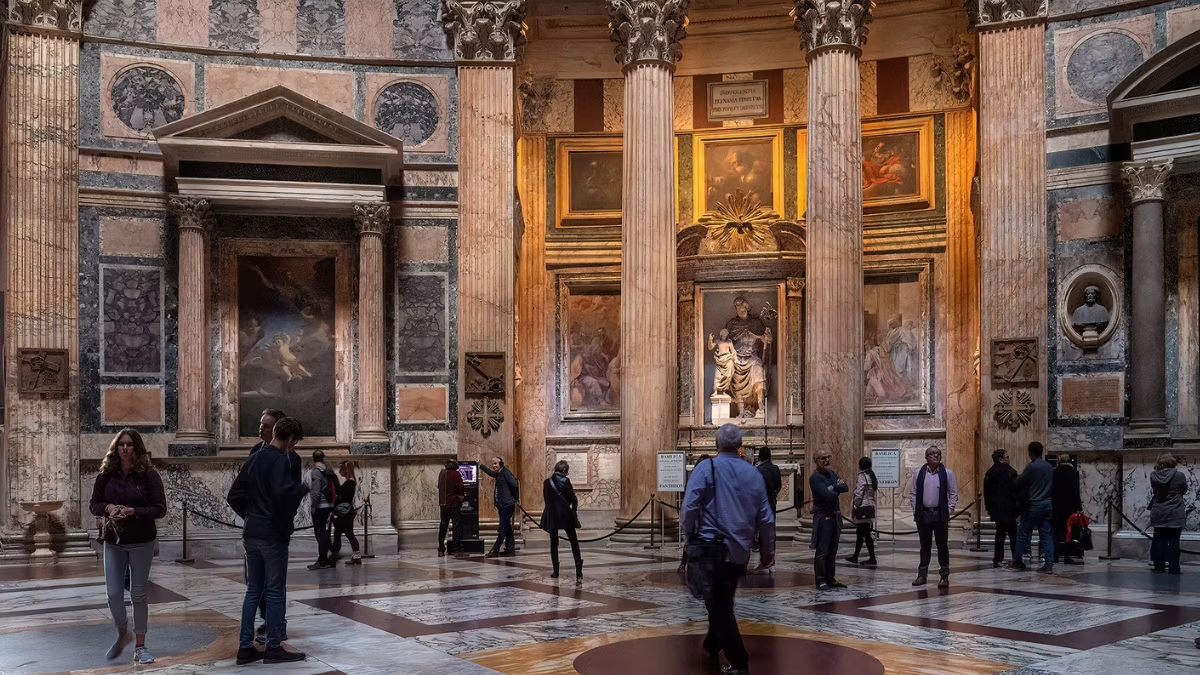
The Pantheon contains the tombs of Victor Emmanuel II (Italy’s first king, died 1878) and Umberto I (Italy’s second king, assassinated 1900), along with Umberto’s wife Queen Margherita of Savoy (died 1926). Victor Emmanuel II’s tomb is in the second niche on the right as you enter. Umberto I and Queen Margherita’s tomb is in the first niche on the right. Volunteer honour guards from the National Institute of the Guard of Honour to the Royal Tombs often stand watch during opening hours.
Standing before the royal tombs in the Pantheon, two things strike you immediately. The first is their scale — these are grand, imposing monuments, more architecturally assertive than Raphael’s simple sarcophagus nearby. The second is the porphyry — the deep purple-red stone reserved in antiquity exclusively for emperors and, later, royalty — placed deliberately before both tombs as a visual declaration of dynastic dignity. The story of how these kings came to rest in one of the ancient world’s greatest buildings is also the story of how Italy was made.
Why the Pantheon?
The choice to bury Italy’s first kings in the Pantheon rather than the dynastic capital of Turin was a deliberate political decision. Burying the first king of a united Italy in Rome’s most ancient and prestigious monument connected the new state to the grandeur and permanence of ancient Rome. Victor Emmanuel II had requested burial in Turin; his son Umberto I accepted Rome’s request instead.
When Italy was unified under Victor Emmanuel II in 1861, the new state faced an acute legitimacy problem. The peninsula had been divided into separate kingdoms, duchies, and papal territories for over a thousand years. The unification was recent, contested, and in some quarters resented. The new state needed symbols — and it needed to connect itself visually and historically to the most authoritative Italian past available.
Ancient Rome was that past. By burying Italy’s first king in the Pantheon — the most complete, most visited, most culturally prestigious monument from antiquity — the state made a statement: we are not merely the heirs of Piedmont-Sardinia, we are the heirs of Rome itself. The choice was deliberate political theatre, and it has proven extraordinarily durable. The royal tombs remain one of the most visited features of the Pantheon, attended by an honour guard of volunteers more than 140 years after the first burial.
Victor Emmanuel II (1820–1878)
Who Was He?
Victor Emmanuel II was born on 14 March 1820 in Turin as the eldest son of King Charles Albert of Piedmont-Sardinia. He became King of Sardinia-Piedmont in 1849 after his father abdicated following a disastrous military defeat by Austria. He appointed Camillo Benso, Count of Cavour, as his Prime Minister — a partnership that would prove decisive. Cavour provided the diplomatic and political intelligence; Victor Emmanuel provided the military credibility and the dynastic legitimacy.
The unification of Italy was achieved through a combination of Cavour’s diplomacy, Garibaldi’s military campaigns in the south, and a sequence of plebiscites by which the various Italian states chose to join the Kingdom of Sardinia. On 17 March 1861, the first Italian Parliament declared Victor Emmanuel King of Italy — the first ruler of a unified Italian state since the fall of the Roman Empire in the 5th century.
He entered Rome on 20 September 1870 — the final act of unification, achieved after the withdrawal of French troops protecting the Papal States. The city became the capital of unified Italy on 2 July 1871. Victor Emmanuel’s excommunication from the Catholic Church, incurred during the wars of unification, was lifted shortly before his death.
He died in Rome on 9 January 1878. The Italian people called him Padre della Patria — Father of the Fatherland — borrowing the ancient Roman title applied to Cicero and Augustus.
His Tomb
Victor Emmanuel II had expressed a wish to be buried in Turin, in accordance with Savoy dynastic tradition. His son and successor Umberto I overrode this, accepting the request of the Roman city government that the first king of unified Italy be buried in the capital — specifically in the Pantheon.
The tomb was designed by architect Manfredo Manfredi and built between 1885 and 1888 in the second niche on the right as you enter. It consists of a large bronze plaque surmounted by a Roman eagle and the arms of the House of Savoy. The inscription reads:
VITTORIO EMANUELE II — PADRE DELLA PATRIA
An eternal flame burns in front of the tomb in memory of his grandson Victor Emmanuel III, who died in exile in Egypt in 1947.
Umberto I (1844–1900)
Who Was He?
Umberto I was the second king of unified Italy, succeeding his father on 9 January 1878. His reign was eventful and increasingly difficult. Italy’s disastrous attempt to establish a colonial presence in East Africa ended at the Battle of Adwa in 1896 — a catastrophic defeat at the hands of the Ethiopian army and a humiliation that damaged his prestige significantly.
Domestically, government responses to labour unrest — including military repression of workers in Milan in 1898, in which dozens were killed — generated lasting popular anger. It was in this context that the Italian-American anarchist Gaetano Bresci decided to kill him.
On 29 July 1900, Umberto was shot four times in Monza as he returned from an athletic prize-giving. He died almost immediately. Bresci declared at trial that he had acted for those killed in Milan in 1898. His assassination had an unexpected consequence: Leon Czolgosz stated the following year that it had inspired him to shoot US President William McKinley, who died of his wounds in September 1901.
His Tomb
Umberto I was buried in the first niche on the right as you enter — the first niche clockwise from the entrance. His tomb was designed by Giuseppe Sacconi (architect of the Vittoriano monument) and completed after Sacconi’s death by his pupil Guido Cirilli.
The tomb consists of a large slab of alabaster mounted in gilded bronze. The frieze bears allegorical relief figures representing Generosity (by Eugenio Maccagnani) and Munificence (by Arnaldo Zocchi). The royal arms are displayed on an altar by Cirilli.
Queen Margherita of Savoy (1851–1926)
Margherita of Savoy was Umberto I’s wife and queen consort from 1878 until his assassination in 1900. She is widely remembered today as the queen after whom the Margherita pizza was named — according to tradition, the pizzaiolo Raffaele Esposito created a pizza in the colours of the Italian flag during her 1889 visit to Naples and named it for her. Food historians debate whether this story is accurate, but the tradition is firmly established in Italian culture.
She outlived her husband by 26 years, dying on 4 January 1926. She was permitted burial in the Pantheon alongside Umberto I — their sarcophagi rest side by side within the same niche. A plaque identifies her resting place.
The Porphyry: A Note on the Purple Stone
The deep purple-red stone placed before the royal tombs is porphyry — specifically imperial porphyry, quarried exclusively at Mons Porphyrites in the Egyptian desert and used in antiquity only for imperial monuments and burials. Its placement here was a deliberate quotation of imperial Roman tradition — placing the first kings of unified Italy in visual and symbolic continuity with the Roman emperors whose capital they had inherited. The porphyry altar form before both tombs is designed in the shape of an ancient Roman altar, reinforcing the connection.
The Honour Guard
The National Institute of the Guard of Honour to the Royal Tombs was founded in 1878 by veterans of the Italian Wars of Independence. Volunteers from the institute — in distinctive uniforms — can often be seen standing at attention beside the royal tombs during the Pantheon’s opening hours. They are civilian volunteers, not paid state employees, and their organisation has existed continuously since 1878, surviving both the Fascist period and the abolition of the Italian monarchy by referendum in 1946.
The presence of the honour guard is one of the Pantheon’s most unexpected sights — uniformed figures standing vigil over 19th-century royal tombs inside a nearly 2,000-year-old ancient Roman building is an only-in-Rome collision of historical periods.
Frequently Asked Questions
Is Victor Emmanuel II buried in the Pantheon?
Yes. He died in Rome on 9 January 1878 and was buried in the second niche on the right as you enter.
Is Umberto I’s tomb the same as Victor Emmanuel II’s?
No — they are in adjacent niches. Victor Emmanuel II is in the second niche on the right; Umberto I and Queen Margherita are in the first niche on the right.
Why is there an eternal flame at Victor Emmanuel II’s tomb?
The flame burns in memory of his grandson Victor Emmanuel III, who died in exile in Egypt in 1947. His remains were not returned to Italy until 2017.
Who is the honour guard at the royal tombs?
Volunteers from the National Institute of the Guard of Honour to the Royal Tombs, a civilian organisation founded in 1878 by veterans of the Italian Wars of Independence.
Why did they choose the Pantheon rather than a royal chapel?
The choice was a political decision by the new Italian state — burying the first king of unified Italy in Rome’s most ancient monument connected the modern state to the grandeur of ancient Rome.
Is the Margherita pizza actually named after Queen Margherita?
The traditional story says yes — supposedly created during her 1889 Naples visit. Food historians debate whether the story is historically accurate, but it is firmly established in Italian popular culture.
